











Key Takeaways:
- Virgin acrylic costs $3.20-$4.00 per kilogram while PLA ranges $2.52-$3.38 per kilogram with recycled acrylic achieving cost-neutral pricing in some formulations.
- Sustainable materials carry -20% to +80% cost premiums with recycled cardboard reducing costs 20% while bamboo adds 80% premium over traditional acrylic baseline.
- Break-even timeline reaches 3-5 years for sustainable displays when accounting for the Social Cost of Carbon at $190 per ton CO₂e and avoided disposal expenses.
- High-volume injection molding costs $0.78 per piece at 10,000 units versus 3D printing at $5.60 per piece with tooling costs approximating $10,000 making runs under 1,000 units economically unfeasible.
- Patagonia achieved a 4.2-year break-even despite 65% cost premium through 38% carbon reduction while IKEA diverted 2,300 kg waste with 87% durability after 18 months at 42% premium.
The question isn't whether sustainable displays cost more upfront—they often do. From durable business card display holders to large-scale retail fixtures, the real question is whether they cost more over time. Material prices tell only part of the story. Replacement frequency, disposal costs, and brand value complete the calculation.
Understanding true cost requires comparing total lifecycle expenses, not just purchase price. Traditional acrylic ranges from $3.20 to $4.00 per kilogram. Sustainable alternatives span -20% to +80% of that baseline. Break-even typically occurs within 3-5 years when factoring all costs.
Businesses face mounting pressure to adopt sustainable materials while controlling operational budgets. Procurement teams must justify premium pricing to stakeholders. Marketing departments demand eco-friendly solutions that maintain professional appearance. The challenge lies in balancing environmental responsibility with fiscal accountability.
This analysis examines actual cost data from material sourcing through end-of-life disposal. Real-world case studies from Patagonia, IKEA, and Whole Foods provide validation. The goal: determine when sustainable displays cost less, when traditional acrylic makes financial sense, and how to calculate the difference accurately.
What Are Acrylic Display Stands, and Why Does Price Comparison Matter?
Display stands represent ongoing operational expenses for commercial environments. Material choice affects budgets across multiple locations and replacement cycles. Cost differences multiply quickly at scale.
How are acrylic display stands used in retail, hospitality, and corporate settings?
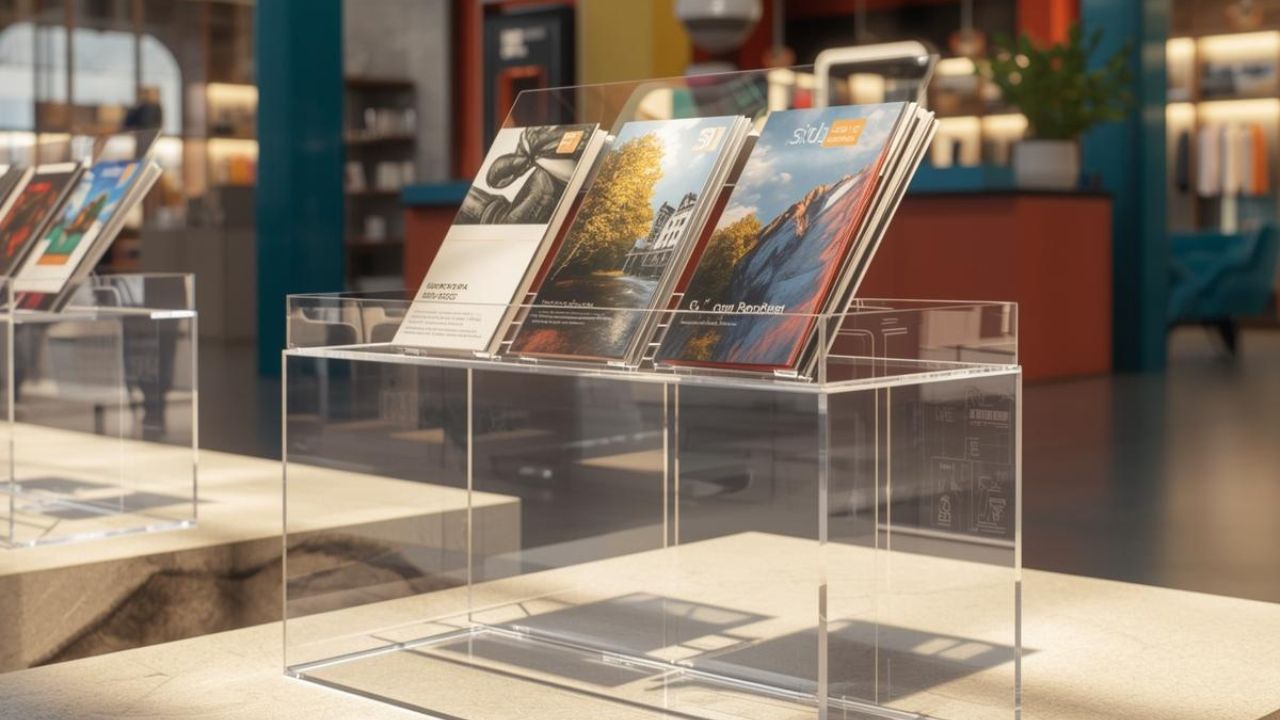
Acrylic brochure holders serve as point-of-purchase displays in commercial environments. Retail stores, hotels, hospitals, and corporate offices rely on these fixtures for product information and marketing materials. High-traffic locations require durable solutions withstanding constant customer handling.
Display stands function as 24/7 information delivery tools without staff intervention. Professional appearance maintains brand standards while organizing promotional content. Material durability directly impacts replacement budgets.
Why does pricing matter more for bulk and repeat commercial orders?
Volume negotiations reduce per-unit costs significantly for sustainable materials. Large retailers purchasing thousands of kilograms annually see substantial cost differences. For 100-store chains, material choices create compounding financial impact.
Repeat orders favor materials with consistent quality and extended replacement cycles. Single-location purchases absorb cost premiums differently than multi-site deployments. Scale determines whether premium pricing becomes manageable or prohibitive.
What Is Considered a Traditional Acrylic Display Stand?
Traditional stands use virgin acrylic derived from petrochemical processes. This baseline material offers established performance characteristics and predictable pricing. Mature manufacturing infrastructure provides supply chain stability.
What materials and fabrication methods define traditional acrylic stands?
Virgin acrylic (PMMA—Polymethyl methacrylate) represents the industry standard baseline. Fossil fuel derivation through petrochemical processes creates the raw material. Standard fabrication includes cutting, thermoforming, heat bending, and polishing.
Established manufacturing processes benefit from mature economies of scale. Global supply chains provide price stability. Traditional methods optimize for high-volume production efficiency.
Why is virgin acrylic still widely used for display manufacturing?
Virgin acrylic delivers high clarity and professional appearance consistently. Established supply chains prevent price volatility. Manufacturing infrastructure supports rapid production scaling.
Traditional acrylic lifespan reaches 1-3 years in retail environments before scratching, clouding, or chipping compromise appearance. Susceptibility to damage drives replacement cycles. Mature production systems keep unit costs predictable despite environmental drawbacks.
What Is Considered a Sustainable Acrylic Display Stand?
Sustainable displays incorporate recycled content, bio-based materials, or renewable resources. Material sourcing determines sustainability claims. Verification through certifications separates legitimate options from greenwashing.
What materials are commonly labeled as sustainable in display manufacturing?
Recycled PMMA (rPMMA) utilizes post-industrial or post-consumer acrylic waste. Recycled PET (rPET) and recycled HDPE/PP offer widely available cost-effective alternatives. Polylactic Acid (PLA) derives from corn starch or sugarcane as a bio-based option.
Additional sustainable options include bamboo, hemp composites, cork, and biodegradable composites. Materials with verified post-consumer recycled (PCR) content meet certification standards. Bio-based PE maintains identical properties to fossil PE while reducing carbon footprint.
The sustainable materials category encompasses diverse options with varying environmental profiles. Recycled content diverts waste from landfills while reducing virgin material demand. Bio-based materials utilize renewable feedstocks instead of fossil fuels. Biodegradable options break down under specific conditions, though industrial composting facilities remain limited.
Material selection within the sustainable category requires understanding specific environmental benefits. Recycled acrylic offers familiar performance characteristics. PLA provides composting potential but requires controlled conditions. Bamboo delivers renewable sourcing with rapid growth rates. Each material serves different priorities—waste reduction, carbon footprint minimization, or renewable resource utilization.
How do recycled and low-impact materials differ from standard acrylic sheets?
Recycled acrylic requires up to 90% less production energy than virgin acrylic. Recycled HDPE and polypropylene show 70% lower cradle-to-gate carbon emissions compared to virgin plastic. Recycled plastic GHG emissions drop 42.8% versus virgin materials.
Some recycled formulations achieve cost-neutral pricing versus virgin acrylic. Mechanical recycling can produce slight discoloration or reduced optical quality. Chemical recycling maintains virgin-level clarity but requires energy-intensive processing.
What Are the Primary Cost Drivers for Acrylic Display Stands?
Material sourcing, fabrication complexity, and production volume determine final pricing. Raw material costs establish baseline pricing. Manufacturing processes add labor and equipment expenses. Custom specifications multiply both factors.
How does raw material sourcing affect per-unit pricing?
Virgin acrylic (PMMA) costs $3.20 to $4.00 per kilogram. Polylactic Acid (PLA) ranges from $2.52 to $3.38 per kilogram—competitive to slightly higher. Recycled acrylic (Recrylic) prices equivalent to virgin or slightly lower.
Conventional plastic raw material costs $1.20 to $1.50 per kilogram. Biodegradable plastic raw material ranges $2.50 to $4.00 per kilogram. Material selection determines 40-60% of total product cost.
Cost premiums by material type: Recycled acrylic adds +20%, PLA bioplastic +40%, biodegradable composite +30%, bamboo +80%, hemp composite +60%, cork +50%. Recycled cardboard reduces costs by -20%. Biodegradable plastics generally cost 20-30% more than traditional plastics due to specialized sourcing.
How do cutting, bending, and polishing steps influence labor costs?
Specialized machinery for eco-friendly materials prevents economies of scale achievement. Bamboo requires different fabrication techniques—lamination and joining versus simple cutting and thermoforming. PLA's lower heat deflection temperature limits thermoforming applications.
Manufacturing complexity varies significantly with sustainable materials. Labor and tooling costs increase with specialized production requirements. Standard acrylic processing uses established equipment with optimized workflows.
Why do custom sizing and prototyping impact pricing quickly?
Injection molding tooling costs approximately $10,000. This expense makes injection molding economically unfeasible for production runs under 1,000 units. 3D printing offers cost advantages for low-volume custom orders.
High-volume comparison at 10,000 units: injection molding costs $0.78 per piece while 3D printing costs $5.60 per piece. Custom designs prevent achieving standardized product economies of scale. Prototyping adds upfront costs before production begins.
How Do Sustainable Materials Change Upfront Pricing Compared to Traditional Acrylic?
Sustainable materials typically carry higher initial unit costs. Production volume, manufacturing complexity, and supply chain maturity explain these premiums. However, specific formulations achieve price parity with traditional options.
Why can recycled or eco-focused materials appear more expensive initially?
Specialized production prevents sustainable materials from achieving mass-produced acrylic's economies of scale. Lower-volume production runs increase per-unit costs. Quality control for high-clarity recycled plastic requires strict processing, sometimes exceeding virgin material cost.
Eco-friendly materials often require specialized machinery, increasing upfront investment. Producing high-clarity food-grade recycled plastic costs more than virgin material. Limited supplier networks create pricing inefficiencies compared to established acrylic supply chains.
When do sustainable materials price similarly to traditional acrylic?
Recycled acrylic marketed under brands like Recrylic costs the same as virgin acrylic. Some recycled plastic formulations eliminate initial cost barriers entirely. PLA can reach as low as $2.52 per kilogram, making it competitive with virgin acrylic at $3.20 to $4.00 per kilogram.
Recycled materials provide near-perfect cost-neutral solutions in certain formulations. Innovation rapidly eliminates initial price premiums for specific materials. Market maturity determines when sustainable options achieve pricing parity.
What Should Be Included in a Fair Price Comparison Beyond Unit Cost?
Purchase price represents only initial investment. True cost analysis includes durability, replacement frequency, disposal expenses, and regulatory compliance. Total Cost of Ownership (TCO) reveals actual financial impact over time, often reversing initial cost comparisons when considering the complete ROI analysis.
How do durability and lifespan affect long-term cost?
Typical acrylic stands cost $50 upfront but total replacement costs exceed $200 over intended lifespan. Bamboo and high-quality recycled plastics engineered for longer service life than standard acrylic. Properly matched sustainable materials to environments achieve 80-95% of traditional acrylic durability.
IKEA case study demonstrated PLA holders with 87% remaining functional after 18 months versus 95% for acrylic. Materials designed for extended lifespan reduce total cost through fewer replacements. Durability directly impacts multi-year budget projections.
Why do replacement frequency and breakage matter in real budgets?
Traditional acrylic susceptibility to scratching, clouding, and chipping drives relatively short lifespans. Frequent replacement due to damage creates compounding costs. High-traffic retail environments accelerate wear and replacement requirements.
Replacement cycles multiply both financial and environmental impacts across multiple locations. Each replacement includes procurement costs, shipping expenses, installation labor, and disposal fees. Annual replacement budgets accumulate quickly for large operations.
A 50-store retail chain replacing displays twice annually faces different economics than single-location businesses. Multiply $50 per unit by 100 displays per location by 50 stores by two replacement cycles: $500,000 annually. Extending lifespan by just six months reduces that to $333,333—a $166,667 annual saving.
Disposal costs add hidden expenses. Recycling PMMA requires complex chemical recycling (pyrolysis), translating to higher business costs. France's packaging removal tax reaches €0.64 per kilogram for certain materials. Many facilities reject acrylic entirely, sending it to landfills where tipping fees apply.
How do reorder consistency and quality control factor into cost?
Recycled material feedstock consistency affects quality and pricing stability. Post-industrial recycled content offers more consistent quality control than post-consumer materials. Established recycling infrastructure provides reliable supply chains.
Material substitution plans required for some sustainable options due to supply variability. Consistency ensures predictable budgeting across fiscal years. Quality variations create hidden costs through increased rejection rates or customer complaints.
How Do Manufacturing Methods Affect the Final Price of Each Option?
Production efficiency determines per-unit costs beyond raw materials. Waste reduction, shipping optimization, and supply chain proximity influence final pricing. Manufacturing location affects both cost stability and lead times.
How does precision fabrication reduce waste and hidden costs?
Precision cutting technology minimizes scrap material during fabrication. Digital integration and modular designs reduce material requirements. Flat-packable designs optimize shipping density and reduce packaging waste.
3D printing enables on-demand production with minimal waste versus traditional manufacturing. Waste reduction in production processes achieves measurable cost savings. Efficient fabrication lowers overall unit costs regardless of material choice.
Why does U.S.-based production influence pricing stability?
Local sourcing reduces transportation emissions and fuel costs. Lighter materials—bioplastics, bamboo, recycled cardboard—decrease shipping expenses. Better supply chain visibility and quality control emerge from proximity.
Reduced dependency on global supply chain volatility prevents price spikes. Partnership with regional manufacturers minimizes overall supply chain costs. Domestic production eliminates tariff exposure and currency exchange risks.
When Are Sustainable Acrylic Display Stands the More Cost-Effective Choice?
Long-term deployment scenarios favor sustainable materials despite higher upfront costs. High-traffic usage, repeat orders, and extended service life change cost calculations. Total Cost of Ownership analysis reveals sustainable advantages.
How does high-traffic usage change cost calculations?
Break-even typically achieved within 3-5 years when accounting for brand value, customer loyalty, and avoided waste disposal costs. Total Cost of Ownership includes durability, end-of-life costs, and monetization of environmental impact. Social Cost of Carbon (SCC) stands at $190 per ton CO₂e according to EPA central estimates.
Carbon savings monetization ranges $0.475 to $0.665 per kilogram when using PLA versus traditional acrylic. Traditional acrylic (PMMA) generates 3.0 to 4.0 kg CO₂e per kilogram. Sustainable PLA produces 0.5 to 1.2 kg CO₂e per kilogram—saving approximately 2.5 to 3.5 kg CO₂e per kilogram.
For large-scale retailers purchasing thousands of kilograms annually, environmental liability savings become substantial. High-traffic locations accelerate return on investment through extended replacement cycles. Durability advantages compound across multiple locations.
Why do repeat orders favor longer-lasting materials?
Sustainable materials engineered for greater longevity generate long-term savings. Reduced replacement frequency lowers total procurement costs over time. Volume negotiations reduce per-unit costs for repeat sustainable material orders.
Economies of scale and technological advancements narrow price gaps between virgin and recycled options. Established supplier relationships improve pricing for ongoing orders. Predictable reorder schedules enable better supplier negotiations.
When Are Traditional Acrylic Display Stands the More Practical Option?
Short-term applications and simple designs minimize sustainable material advantages. Initial cost sensitivity outweighs lifecycle benefits for specific use cases. Traditional acrylic remains practical for certain deployment scenarios.
How do short-term promotions and temporary displays affect value?
Short-term promotional displays don't benefit from long-term durability advantages. Initial cost premium for sustainable materials is harder to justify for single-use applications. Temporary installations lasting weeks or months don't achieve break-even timelines.
Simple cost comparison without lifecycle analysis favors lower upfront pricing. Promotional campaigns requiring frequent design changes reduce material reuse opportunities. Disposal costs matter less for infrequent one-time purchases.
Why do simple designs minimize material cost differences?
Standardized simple designs allow both traditional and sustainable materials to use established manufacturing processes. Complex custom designs amplify cost differences through specialized fabrication requirements. Basic flat displays minimize processing differences between material types, similar to considerations for standard sign holders and ad frames.
Standard sizes and shapes reduce tooling and setup cost variations. High-volume standard products achieve better pricing regardless of material choice. Custom specifications magnify sustainable material premiums through specialized production.
What Questions Should Buyers Ask Before Paying More for "Green" Displays?
Verification separates genuine sustainability from marketing claims. Specific certifications and measurable metrics provide objective evaluation criteria. Due diligence protects budgets and brand reputation.
What proof should vendors provide for sustainability claims?
Demand FSC certification for wood and bamboo materials. Verified post-consumer recycled content certification prevents unsubstantiated claims. Compostable certifications from BPI (Biodegradable Products Institute) and TÜV Austria ensure industrial composting compatibility.
Life Cycle Assessment (LCA) data should be available from suppliers for objective comparison. Focus shifted from vague "eco-friendly" language to verifiable metrics like 42.8% reduction in environmental impact. Transparency in sourcing prevents greenwashing and supports procurement accountability.
How can buyers avoid misleading price comparisons?
Compare total cost of ownership, not just initial unit price. Verify whether quoted prices include shipping, customization, and minimum order quantities. Request durability data and expected replacement timelines.
Ask about end-of-life disposal costs and requirements. Confirm material composition percentages—for example, cork composites typically contain 95% cork with 5% eco-friendly binder. Require documentation of claimed energy savings or carbon reductions.
How Can Businesses Decide If Green Is Actually More Expensive for Their Order?
Decision frameworks comparing multiple cost factors reveal true expense. Unit price, lifespan, and reorder requirements combine to determine actual costs. Case studies provide real-world cost validation.
How should unit price, lifespan, and reorder needs be compared together?
Patagonia case study: 65% cost premium, 38% carbon reduction, 4.2-year break-even timeline. IKEA pilot: 42% cost premium, 2,300 kg waste diverted, 87% durability after 18 months. Whole Foods implementation: 28% cost increase, 35% reduction in display refresh costs, 45% plastic waste reduction.
Total cost calculation framework: Initial unit cost + (replacement frequency × replacement unit cost) + disposal costs = true total cost. Break-even timeline reaches 3-5 years for most sustainable materials. Sustainable materials reduce long-term costs despite higher upfront investment.
Strategic material selection by use case optimizes overall cost structure. High-traffic permanent areas justify bamboo or recycled acrylic at +20% to +80% premium. Seasonal temporary displays benefit from recycled cardboard at -20% cost.
What decision framework helps buyers choose without assumptions?
Calculate total annual display budget across all locations. Determine average replacement cycle for current displays. Assess disposal costs under current waste management contracts.
Factor regulatory compliance costs—France's packaging tax reaches €0.64 per kilogram. Consider brand value enhancement from sustainability positioning. Evaluate customer perception impact—73% of Patagonia customers noticed sustainable displays.
Volume-based pricing considerations: Bulk purchasing agreements reduce per-unit costs for sustainable materials. High-volume orders (10,000+ units) benefit from injection molding cost efficiency. Low-volume custom orders (<1,000 units) benefit from 3D printing or simple fabrication.
Application-specific selection: Indoor climate-controlled spaces suit PLA despite +40% premium and lower heat resistance. Outdoor or high-moisture environments require bamboo with proper sealing or recycled acrylic. Clarity requirements eliminate hemp composites despite other advantages.
Phased implementation allows testing before full-scale commitment. Pilot programs test materials in limited locations before deployment. Early supplier engagement (6-12 months) reduces implementation risk and improves pricing negotiations.
Create a material selection matrix based on specific requirements. Evaluate each display location for traffic level, environmental conditions, brand visibility, and expected service life. Match material characteristics to requirements rather than applying a single solution across all applications. High-visibility flagship stores justify premium sustainable materials. Back-office administrative areas accept lower-cost traditional options.
Budget allocation strategies differ for new deployments versus replacement programs. New installations allow strategic material selection from the start. Replacement programs require gradual transition planning. Prioritize highest-traffic locations for initial sustainable material adoption to maximize brand impact and durability benefits.
Understanding the Complete Cost Picture
Price comparison requires analyzing total lifecycle expenses, not isolated purchase prices. Sustainable displays often carry 20-80% upfront premiums but achieve break-even within 3-5 years. Material selection depends on application requirements, replacement cycles, and brand positioning.
Traditional acrylic remains practical for short-term promotions and simple designs. Sustainable alternatives deliver superior value for permanent fixtures, high-traffic locations, and repeat orders. Proper material matching to specific use cases optimizes both cost and performance.
Verification through certifications ensures claimed benefits materialize. FSC, BPI, and TÜV Austria certifications validate sustainability claims. Life Cycle Assessment data provides objective comparison metrics beyond marketing language.
Strategic implementation starts with high-visibility areas to maximize brand impact while managing costs. Volume negotiations improve pricing for bulk orders. Total Cost of Ownership analysis reveals true expenses including disposal, replacement frequency, and regulatory compliance.
Make Informed Decisions on Display Material Costs
Displays and Holders specializes in both traditional and sustainable acrylic display solutions with transparent pricing and verified material specifications. Our team provides detailed cost comparisons including total lifecycle analysis, helping businesses understand true expenses beyond initial purchase price.
Contact Displays and Holders today for customized price quotes comparing traditional and sustainable options for your specific requirements. We deliver expert guidance on material selection, volume pricing, and long-term cost optimization. Our comprehensive approach includes durability data, replacement projections, and ROI analysis supporting informed procurement decisions. For those exploring additional display options, our business card displays demonstrate the same commitment to quality and value across all product lines. Get in touch to discuss how we can help optimize your display investment.