











Key Takeaways
- The wall is the constraint, not the fixture. Identify your substrate first: gypsum, wood stud, steel stud, and concrete carry loads that differ by more than 10 times.
- Distance from the wall changes the load math. Ask suppliers for a moment rating in ft-lb at a stated hook length, not just a pound figure.
- Peak sales height and ADA reach limits don't fully align. Research places the strongest-selling zone around 44 to 53 inches, while ADA caps reachable elements at 48 inches.
- Slatwall accessories almost always exceed ADA protrusion limits. Faceouts, waterfall arms, and knife brackets project 8 to 16 inches, well past the 4-inch cap.
- Insert type affects panel strength more than core grade. A standard aluminum insert nearly doubles an MDF panel's breaking load.
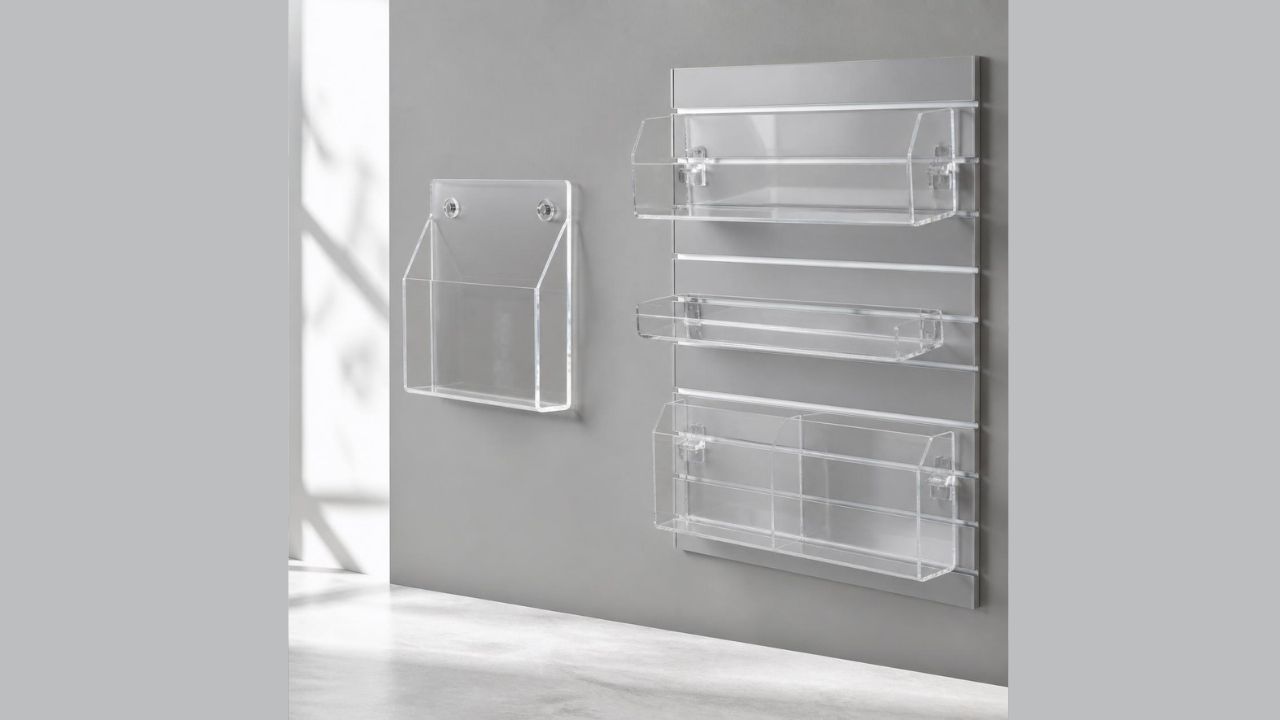
Wall-mounted and slatwall display systems look simple: bolt panels to a wall, hang some hooks, done. But the wall underneath decides whether that clear slatwall display holds or fails.
Below, you'll find what determines slatwall performance: substrate capacity, anchor selection, cantilever math, literature wall design, accessibility code, mounting height research, and panel construction — enough to plan a wall that meets code, holds its load, and puts your highest-selling items where customers can reach them.
Wall-Mounted and Slatwall Display Systems Compared to Other Wall Options
Slatwall is one system in a family of eight wall-mount options. Each attaches, reconfigures, and holds weight differently, depending on your wall, your lease, and how often your merchandising changes.
Common Types of Wall-Mount Display Systems
| System | How It Reconfigures | Suited For |
| Slatwall | Accessories slide anywhere along the groove | Retail, apparel, footwear |
| Gridwall | Hooks reposition at intersections | Pop-ups, seasonal sets |
| Pegboard | Hooks move hole to hole | Back-of-house, workshops |
| Slotted standard & bracket | Brackets clip in at fixed increments | Stockrooms, heavy goods |
| Rail or cleat | Fixtures slide, height fixed | Waiting rooms, lobbies |
| Magnetic | Instant, anywhere on the surface | Steel partitions, trade shows |
| Adhesive | Effectively single-use | Leased space, glass, tile |
| Direct-to-wall fixed | None | One holder, permanent |
Flexibility and Load Capacity Differ by System
Duty rating, not finish, decides load capacity. Panels with factory aluminum inserts reach medium duty; vinyl-insert panels stay light duty, and no tier reaches heavy duty industry-wide. For walls that don't exist, modular slat panel towers work instead: 2'×2' plastic panels, grooves on one face and pegboard holes on the other, about 6 lb each, stacking into freestanding towers up to 12' tall.
Environmental and Tenant Restrictions Affect System Choice
Environment and lease terms narrow the field fast. Retail floors favor slatwall or gridwall, where reconfiguration makes wall damage an accepted cost. Clinical spaces favor rail, cleat, or direct-to-wall pockets for cleanable surfaces. Lobbies favor rail, cleat, or magnetic mounts on steel, where finish outweighs flexibility. Trade shows favor magnetic or modular towers, since there's often no stud to anchor into.
Lease terms matter too. Slatwall penetrates the wall on a grid and usually needs backing; rail systems concentrate penetration into one or two lines; magnetic and adhesive leave almost nothing. At lease end, restoration means that flexibility gets paid for twice: once at install, once at exit.
Wall-Mounted and Slatwall Display Systems Start With the Wall Substrate
The wall decides what a display can carry, not the fixture. Buyers typically pick a system first and the substrate second — that order should flip.
Typical Wall Substrates and Their Load Capacities
Five substrates cover nearly every US commercial interior: hollow gypsum board, gypsum over wood stud (16" centers), gypsum over light-gauge steel stud, concrete masonry unit, and cast concrete. Capacity across these five swings by more than 10×.
Anchor Performance Across Different Substrates
| Anchor | Substrate | Ultimate | Allowable |
| SNAPTOGGLE BB ¼" | ½" gypsum | 265 lb | 66 lb (4:1) |
| SNAPTOGGLE BC ⅜" | ⅝" gypsum | 576 lb | 144 lb (4:1) |
| SNAPTOGGLE BB ¼" | Concrete block | 1,080 lb | 270 lb (4:1) |
| Titen HD ¼" | Grout-filled CMU | 1,325 lb | 265 lb (5:1) |
Substrate sets the ceiling; the anchor only gets you partway there. Toggler rates ultimate load at 4:1; Simpson Strong-Tie rates masonry anchors at 5:1 under the IBC — convert both to allowable before comparing. Once converted, the ¼" SNAPTOGGLE in concrete block and the ¼" Titen HD in CMU land almost identically, despite a 5× gap in their ultimate figures.
Studs Beat Anchors for Load-Bearing Capacity
A #10 wood screw with 1" thread penetration into a Douglas Fir-Larch stud holds 135 lb allowable, no safety factor required. The strongest hollow-wall anchor in ½" gypsum tops out around a third of what it reaches in concrete block, and a plain wood screw into a stud beats every gypsum-only anchor except the largest toggles.
Bare gypsum with no anchor holds nothing reliably — no published pull-out value exists for a plain screw in hollow gypsum board. Gypsum owes its strength to the paper facing and “will not adequately support items hung thereon with simply nails or even standard screws” unless driven into the stud. Treat bare gypsum as zero capacity: find the stud, use a toggle, or add backing.
Cantilever Distance Changes Slatwall Load Ratings
Anchor ratings measure a straight pull at the wall face. Slatwall never loads that way — everything hung on a wall sticks out from it, and that distance changes the math.
Load Position Affects Fastener Capacity
Distance from the wall turns weight into leverage. A brochure pocket holds paper 1.5 to 3 inches out; a faceout holds garments 12 inches out; a shelf bracket centers its load at half the shelf's depth. The fastener feels a moment, not a straight pull, and the uppermost fastener in a mounting group carries prying tension well above the item's actual weight.
The Industry Standard Method for Calculating Load Moments
The formula: for a load at the end of a hook, moment (ft-lb) equals weight (lb) times hook length (ft); for a load spread evenly along a hook, moment equals half the weight times prong length. A 10 lb load on a 12" hook and a 20 lb load on a 6" hook carry the same moment: 10 ft-lb. As a rule of thumb, keep hardware within 12" of the wall, spaced every 12", and give a four-foot shelf four brackets, not two.
Evaluating Supplier Load Ratings
Hook length changes the answer, so ask for it. At a 66% working-load limit, a 12" hook on a 120 psi MDF panel with a standard aluminum insert carries about 59 lb; shorten that hook to 6" and it carries about 118 lb. Always ask for the moment rating in ft-lb at a stated hook length.
Literature Wall Design Guidelines for Slatwall
Literature walls run on three decisions: pocket size, pocket depth, and mounting height. Get those right and the wall restocks itself with minimal labor. Get them wrong and you're fighting slumping paper or wasted wall space.
Pocket Sizes and Depths for Different Collateral
| Collateral | Pocket Width | Typical Capacity |
| 4"×9" tri-fold brochure | 4" | ~75 sheets |
| 5.5"×8.5" half-page | 5.5" | Varies |
| 8.5"×11" full page | 8.5" | ~96 sheets |
None of these sizes are standardized — no ANSI, ASTM, or ISO spec governs brochure pocket dimensions. Depth is separate from capacity: 1.57" is the dominant single-tier depth, and a 3.0" version exists for higher volume. But 96 sheets of 20 lb bond paper stacks to roughly 0.4 inches, so depth is sized to keep the top sheet upright and visible, not to fit more paper.
Pocket Configuration Affects Restocking and Density
Single-tier racks give the lowest density but the easiest restocking. Multi-tier racks give the highest density, but bottom tiers drop below comfortable reach. Adjustable racks land in the middle, using a divider mechanism where a single 8.5"×11" slot holds two 4"×9" pamphlets — a good fit when the collateral mix is likely to change.
Pockets That Fit Within ADA-Compliant Reach Zones
The ADA-compliant literature band runs 40" to 48" above the floor — just 8 vertical inches per linear foot of wall. Within that band, a linear foot fits 3 pockets at 4"×9" single-tier, 2 at 5.5"×8.5" single-tier, or 1 at 8.5"×11" single-tier (2 formats with a divider). Pockets can't stack within an 8-inch band, so anything a multi-tier rack adds above 48" is decoration a seated user can't reach.
Accessibility and Building Codes Shape Slatwall Display Design
Two federal rules govern where displays go: reach range and protrusion limits. Both cap how high you mount and how far you stick out. Ignore either one and the display becomes a compliance liability, not just a merchandising choice.
ADA Reach Requirements for Operable Parts
| Reach Type | High Reach | Low Reach |
| Unobstructed forward | 48" | 15" |
| Obstructed forward, ≤20" deep | 48" | — |
| Obstructed forward, >20" deep | 44" | — |
| Unobstructed side | 48" | 15" |
| Obstructed side, 10"–24" deep | 46" | — |
These caps apply only to operable parts. Non-operable elements can sit outside the 15–48" range — that's why a sign holder, which is read but not touched, escapes the 48" ceiling, while a literature pocket, which gets reached into and grasped, does not.
Protrusion Limits Govern Slatwall Attachments
Anything with a leading edge between 27" and 80" high that sticks more than 4" into a walkway breaks the rule, under 2010 ADA Standards §307.2 and IBC §1003.3.3. Handrails get a half-inch more, capped at 4½".
Acrylic literature pockets (1.57"–3.0") and ready to hang wall-mount sign holders (under 2") clear the limit easily. Slatwall accessories almost always bind: faceouts run 12"+, waterfall arms run 14"–16", and knife brackets run 8"–14", two to four times over the limit. That's why slatwall belongs on a sales-floor wall, not a corridor that functions as a means of egress.
Placement Guidelines for Slatwall Faceouts and Accessories
California, Georgia, and Florida all exceed the federal accessibility baseline — check the state standard before defaulting to the ADA minimum. Corridor width alone doesn't guarantee compliance: a 5.5" pilaster in a 60" corridor can still violate §1003.3.3, since the rule applies to the circulation path itself. Reserve faceouts, waterfall arms, and knife brackets for merchandising walls where the protrusion rule doesn't apply, and keep circulation paths clear.
Mounting Height Influences Customer Engagement and Sales
Height sells more than any other display variable. Research points to a band below eye level that runs into ADA's 48" reach ceiling.
Research on Optimal Vertical Placement
A 1994 field study across 60 grocery stores and eight product categories found “a central location is most desirable, on average an elevation of 51–53 inches off the floor.” That range follows ergonomics: preferred viewing angle sits 15° below horizontal, and average eye height runs 59" to 64".
A 2021 eye-tracking study of real shoppers found peak attention lands about 15 inches below eye level, roughly 44" to 49". The two studies measured different things — sales versus attention — so the honest range spans roughly 44" to 53", both below eye height.
Vertical and Horizontal Position Differ in Sales Impact
Vertical position outweighs horizontal position. Moving from the worst to the strongest vertical shelf position lifted unit sales 39% on average; horizontal position moved sales just 15% — vertical is worth roughly 2.5× what horizontal is worth. A controlled test confirms it: moving toothbrushes from a 72" shelf to 56" eye level raised sales 8% and category profit 11%, while displaced toothpaste, a planned purchase, showed no change.
The Conflict Between ADA Reach Limits and Peak Sales Heights
ADA §308 caps reach at 48". The 51"–53" sales peak sits just above that ceiling, so the last few inches of selling power are legally off-limits for anything a customer must reach into or grasp. The 44"–49" attention band fares better, sitting almost entirely inside ADA reach.
Plan a 96" wall in zones: 44"–53" for highest-margin, impulse items; 15"–44" for volume stock within ADA reach; 54"–72" for signage above reach but still visible; 72"–96" for signage and overflow; below 15" for heavy, deliberate-purchase items. One finding worth noting: making a wall easier to browse can backfire — alphabetizing test categories cut sales 5–6% for six months straight.
Key Technical Considerations in Slatwall Panel Construction
Panel construction decides how much weight a slatwall actually holds. Core material, insert type, and groove spacing all factor in, and they don't factor equally.
Panel Core Materials and Inserts Affect Strength
| Core & Insert | Breaking Load |
| 120 psi MDF, no insert | 47.1 ft-lb |
| 120 psi MDF, standard aluminum insert | 89.7 ft-lb |
| 150 psi MDF, standard aluminum insert | 95.0 ft-lb |
Moving from 120 psi to 150 psi core buys about 18% more breaking load. Adding a standard aluminum insert to that same 120 psi core buys about 90% more — insert choice matters roughly five times more than core upgrade. Failure gives no warning: large sections of the panel face pop off abruptly, and loads placed near an exposed edge fail sooner. A stiffer insert, aluminum over plastic, spreads the hook tang's force further and performs better.
Groove Pitch Influences Merchandising Flexibility
3" on-center is the industry standard groove spacing; 6" spacing is a growing alternative for a cleaner “shiplap” look. A 96" tall panel at 3" pitch gives 32 possible mounting heights; at 6" pitch, that drops to 16. No manufacturer has published a load comparison between the two — 6" likely holds more, but the magnitude isn't published.
Panel Installation and Accessory Limits to Know
Standard panels run 4'×8' (48"×96"), ¾" thick, 85–86 lb per sheet, installed with drywall screws through the T-slot bottoms into 2×4 studs at 16" centers — about 43 screws per panel.
Accessory weight limits are where published data falls apart. For the identical no-insert case, sources disagree widely: 10–15 lb per bracket, 25 lb per square foot, 25 lb per linear foot, 15 lb per groove — five different units for what should be one answer. Ask for a test method and a stated moment arm; treat unsupported figures as estimates. Budget for crating too: $35–$75 per crate depending on panel size.
Planning Your Slatwall Display: Integrating Merchandising, Structure, and Compliance
A solid slatwall plan starts with the wall, not the fixture. Substrate sets the load ceiling; anchor type and hook length determine how much of it you can use. Every accessory that projects off the panel adds moment, not just weight.
Compliance and merchandising pull in different directions, and both have to hold. ADA reach and protrusion rules cap what you can mount where, while the sales research points to a peak height just above that cap. The workable answer is zoning the wall: reachable, compliant space for anything a customer touches, and sight-line space above it for everything else. Our slim-profile acrylic sign holders fit naturally into that upper zone, keeping headers, wayfinding, and promotional messaging visible without encroaching on the compliant reach area below.
Contact Displays & Holders to Build Your Slatwall Display
Displays & Holders has manufactured acrylic and plastic display solutions in-house since 1986, in Anaheim, California, and helped more than 100,000 businesses plan displays that hold up and sell.
Whether you need a custom slatwall accessory, a slatwall brochure holder sized to your collateral, a bottom-loading, curved, or angled sign holder, an outdoor or real estate holder, custom printed signs and posters, or a full display buildout, our team can help you spec it right the first time. Custom orders start at just 50 units, and in-stock orders placed before 2 PM PST ship the same day. Browse our most popular displays to see what's available now.
Call us at 714-527-1179, request a quote, or reach out online to talk through your project with Displays & Holders.
Frequently Asked Questions
Q1. What is the difference between slatwall and gridwall displays?
A. Slatwall uses ¾" panels with T-slot grooves cut every 3" on center, so accessories slide anywhere along the groove. Gridwall uses a wire grid where hooks reposition only at grid intersections, giving faster setup but less height precision. Slatwall suits permanent retail floors and apparel displays; gridwall suits pop-ups and trade show booths.
Q2. How much weight can a slatwall panel hold?
A. It depends on the insert, not just the panel material. A 120 psi MDF panel with no insert breaks at roughly 47 ft-lb; the same panel with a standard aluminum insert breaks at roughly 90 ft-lb. Working loads should stay at 66% of breaking load. Ask any supplier for a moment rating in foot-pounds at a stated hook length, not a flat pound figure.
Q3. Which wall anchor holds the most weight for slatwall panels in gypsum board?
A. A ¼" SNAPTOGGLE toggle anchor in ½" gypsum board holds 265 lb ultimate, or 66 lb allowable at a 4:1 safety factor. Where possible, anchor into a stud instead: a #10 wood screw with 1" thread penetration into a Douglas Fir-Larch stud holds 135 lb allowable with no safety factor required. Bare gypsum with no anchor and no stud should be treated as zero capacity.
Q4. What height should I mount a slatwall display for the strongest sales?
A. Retail research places peak sales performance at 51 to 53 inches above the floor. A separate eye-tracking study found peak shopper attention closer to 44 to 49 inches, below eye level. Since ADA reach rules cap anything a customer must touch at 48 inches, place highest-margin items in the 44- to 53-inch band and reserve the space above 54 inches for signage.
Q5. Do slatwall accessories meet ADA protrusion requirements?
A. Most do not, and that's expected. Slatwall faceouts typically project 12 inches or more, and knife shelf brackets run 8 to 14 inches — two to four times over the 4-inch protrusion limit set by ADA §307.2 and IBC §1003.3.3. That's why slatwall belongs on a sales-floor merchandising wall rather than a corridor that functions as a means of egress. Acrylic literature pockets and most wall-mount sign holders project under 3 inches and clear the limit easily.