










Key Takeaways:
- Slatwall weight capacity ranges from 12.5 lbs (un-reinforced MDF) to 250 lbs (Installstrips systems) with mandatory 66% working load safety margins preventing structural failure.
- Location selection drives 71% performance variance with checkout areas achieving 35% conversion, entrance zones 32%, mid-store 27%, while low-traffic corners drop to 12%
- Angled literature holders positioned 30-55 degrees attract 500% more views and improve customer recall by 183% compared to vertical flat displays through ergonomic positioning.
- Optimal height positioning captures standing adults at 50-54 inches eye-level and wheelchair users at 36-48 inches (ADA compliant 36" maximum) simultaneously with multi-level configurations.
- Properly configured slatwall visual merchandising systems deliver 30% sales increases, 40% product engagement improvements, and 20% longer customer shopping times in retail environments.
Slatwall systems transform unused wall space into product and literature display zones capturing customers at multiple eye-level heights simultaneously. Weight capacity spans 12.5-250 lbs depending on system type. Proper planning delivers 30% sales increases, 40% engagement improvements, and 20% longer in-store times through strategic literature placement within optimal 50-54 inch standing and 36-48 inch accessible zones.
What Is a Slatwall Display System and Why Should You Use Integrated Literature Holders?
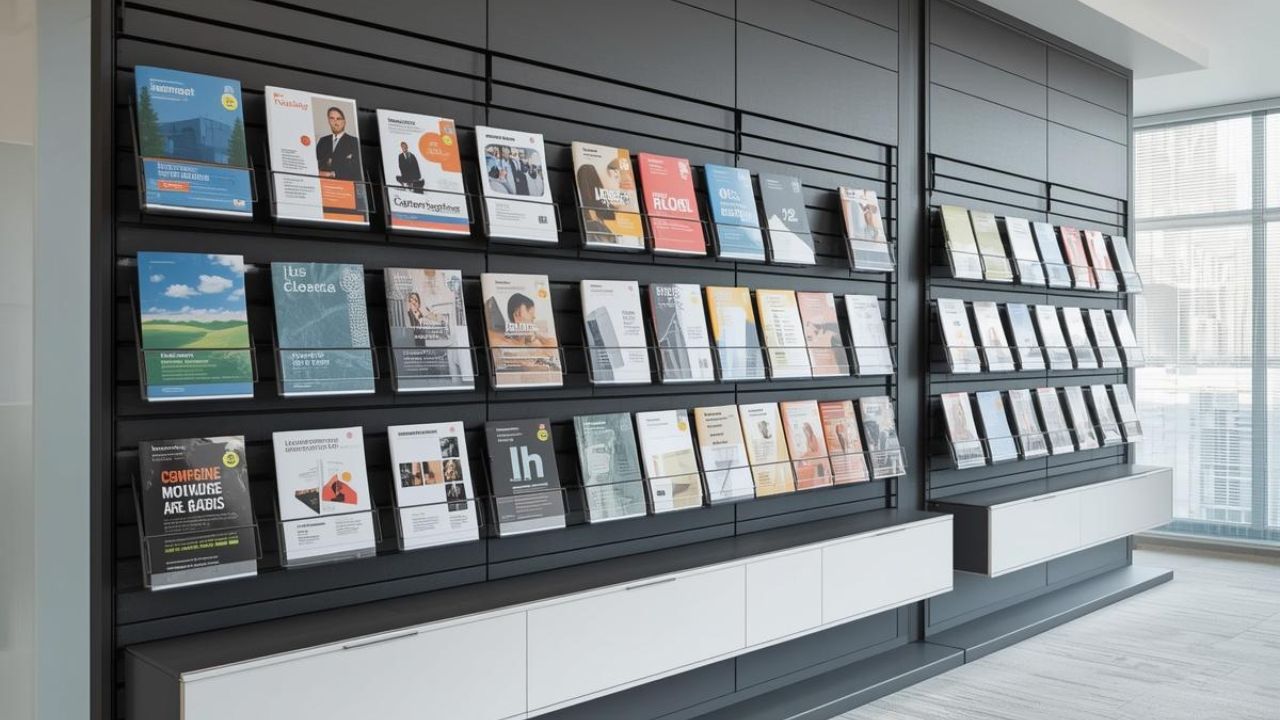
Slatwall panels mount to walls creating modular display surfaces accepting interchangeable accessories. Literature holder integration combines product merchandising with information distribution.
What Are Slatwall Display Systems and How Do They Work?
Slatwall panels feature horizontal grooves accepting standardized hooks and brackets. Weight capacity determines system selection: un-reinforced MDF supports 12.5 lbs, reinforced MDF handles 50 lbs, heavy-duty PVC manages 75 lbs, and Installstrips-reinforced systems carry 250 lbs. Working loads must stay within 66% of breaking capacity maintaining safety margins. Grid patterns enable vertical and horizontal accessory arrangement without permanent mounting holes.
Why Should You Consider Integrating Literature Holders into Your Slatwall System?
Integrated slatwall display systems reduce floor space requirements while maximizing vertical merchandising potential. Modular configuration enables flexible reconfiguration responding to seasonal changes, product launches, or promotional campaigns. Literature placement adjacent to related products increases contextual relevance and customer understanding. Vertical arrangement captures both standing eye-level (50-54 inches) and wheelchair accessible (36-48 inches) zones simultaneously.
How Do Slatwall Displays with Literature Holders Improve Customer Interaction?
Visual merchandising with slatwall systems increases time spent in-store by 20%. Product engagement rises 40% with proper display configuration. Sales increase up to 30% when literature supports product understanding. Interactive displays boost dwell time 35% compared to static alternatives. Each 1% dwell time increase correlates with 1.3% sales increase demonstrating direct engagement-to-revenue connection.
How Do You Plan a Slatwall Display System with Integrated Literature Holders?
Successful planning requires capacity calculation, height positioning, and clearance verification. Literature holder selection matches content volume to system weight limits.
What Are the Key Considerations When Planning a Slatwall System?
Start with structural capacity assessment. Wall mounting requires verification that the structure supports selected system weight: 12.5 lbs for un-reinforced MDF minimum, 250 lbs for Installstrips-reinforced maximum. Maintain 42-inch minimum clearance around wall projections ensuring accessibility compliance. Provide 48-inch minimum aisle width for comfortable browsing. Position literature holders within optimal height zones: 50-54 inches captures standing adults, 36-48 inches serves wheelchair users meeting ADA 36-inch maximum requirement.
How Do You Choose the Right Literature Holder for Your Slatwall System?
Match holder weight plus contents to system capacity staying within 66% working load limit. Pocket depth accommodates literature thickness ranging 1/32 inch to 1/4 inch typical. Angled holders (30-55 degrees) attract 500% more views than vertical flat alternatives improving customer recall by 183%. Hook compatibility with standard slatwall groove spacing ensures secure attachment. Select single-pocket for focused messaging or multi-pocket for variety, understanding multi-pocket configurations increase weight requirements.
How Do Slatwall Displays Maximize Space and Enhance Product Visibility?
Wall mounting frees floor space for traffic flow maintaining accessible aisles. Vertical arrangement positions literature at multiple heights simultaneously covering standing and accessible ranges without separate displays. Grid configuration enables literature placement directly adjacent to related products. Product-literature proximity increases contextual understanding encouraging informed purchase decisions. Coordinated placement transforms walls from barriers into engagement zones.
What Are the Different Types of Literature Holders for Slatwall Displays?
Literature holder types accommodate different content formats, angles, and distribution strategies. Selection balances visibility with space efficiency.
What Is the Difference Between Single-Pocket and Multi-Pocket Literature Holders?
Single-pocket holders deliver focused messaging with simpler content updates. Multi-pocket configurations offer variety requiring more wall space and higher weight capacity. Tiered options (2-tier, 3-tier) stack vertically maximizing literature variety within limited horizontal space. Weight distribution matters: calculate total loaded weight including all pockets before installation ensuring system capacity handles aggregate load within 66% working limit.
Should You Use Brochure Holders, Catalog Holders, or Flyer Holders?
Format selection matches content thickness and size. Standard brochure holders accommodate 4" x 6", 5.5" x 7", and 8.5" x 11" formats. Catalog holders feature deeper pockets for thick, bound materials. Flyer holders use shallow pockets for single-sheet materials. Insert thickness capacity typically spans 1/32 inch to 1/4 inch range. Oversized literature may require custom holders preventing forced fitting that damages materials.
How Do Angled Literature Holders Compare to Flat Holders?
Angled literature holders positioned 30-55 degrees attract 500% more views than vertical flat displays. Customer recall increases 183% with angled versus static vertical positioning. Angle reduces glare improving readability from multiple approach directions. Perpendicular orientation to main traffic flow maximizes visibility. Touchscreen optimal angle research confirms 30-55 degrees off horizontal delivers best ergonomics translating to literature holder positioning. Angled mounting brackets attach to standard slatwall grooves.
What Are the Benefits of Custom Literature Holders for Slatwall Systems?
UV printing enables full-color branding on holder frames transforming functional displays into brand touchpoints. Custom sizing accommodates non-standard literature dimensions eliminating awkward fitting. Branded holders increase recognition by 40% in engagement studies. Professional appearance signals current, maintained content increasing perceived information value. Color matching to corporate brand standards maintains visual consistency across facilities. Hanging display systems complement slatwall installations for comprehensive merchandising coverage.
What Are the Best Locations for Slatwall Displays with Literature Holders?
Location selection drives performance variance exceeding 70% between optimal and poor placements. Traffic patterns and decision points determine effectiveness.
Where Should You Position Slatwall Displays in Retail Environments?
Checkout counter areas achieve 35% conversion representing the highest performance zone. Store entrance walls capture 32% conversion intercepting arriving customers. Mid-store high-traffic aisles deliver 27% conversion (retail average). Low-traffic corners drop to 12% conversion showing 71% decline from optimal placement. End-cap positions leverage natural stopping points. Visual merchandising in retail drives 30% sales increases, 40% product engagement improvements, and 20% longer shopping times when properly configured.
How Do You Place Slatwall Displays in Hospitality or Office Lobbies?
Reception desk adjacency provides visibility within 40-42 inch desk height standard. Waiting area walls capitalize on captive audiences with extended dwell time. Entrance walls capture 32% of arriving visitors during the first impression window. Interactive displays in waiting zones boost dwell time 30-40% compared to static alternatives. Position literature within standing eye-level (50-54 inches) and accessible (36-48 inches) ranges maximizing demographic reach.
Where Are Slatwall Displays Most Effective in Trade Shows and Exhibitions?
Booth perimeter walls maximize literature availability without consuming floor space needed for demonstrations. Demo area adjacency provides supplementary technical information during presentations. High-traffic aisle positions ensure maximum attendee exposure. Interactive displays increase attachment rates on promoted products by 20%. Modular slatwall configuration enables rapid booth reconfiguration between shows adapting to different space allocations.
How Do Materials and Design Influence the Effectiveness of Slatwall Displays?
Material selection affects capacity, durability, appearance, and cost. Design choices impact organization, visual balance, and reconfiguration flexibility.
What Materials Are Best for Slatwall Systems (Wood, Metal, Acrylic)?
Un-reinforced MDF delivers 12.5 lbs capacity at lowest cost suitable for light literature loads. Reinforced MDF increases capacity to 50 lbs (4x improvement) for moderate literature configurations. Heavy-duty PVC supports 75 lbs (6x improvement) with moisture and chemical resistance. Standard with Installstrips achieves 250 lbs capacity (20x improvement) for maximum commercial-grade installations. Always maintain a 66% working load safety margin preventing system failure. Literature holder fronts use clear materials: acrylic delivers 92% light transmittance (clearest), PETG provides 90%, polystyrene offers 89%, polycarbonate gives 88%. Choose wall mount display options based on capacity requirements and environmental conditions.
How Does the Design of the Slatwall System Affect Display Organization?
Grid layout with horizontal and vertical spacing standards creates uniform professional appearance. Vertical spacing accommodates multiple eye-level zones covering 36-48 inch accessible and 50-54 inch standing ranges simultaneously. Modular configuration allows seasonal reconfiguration without reinstallation. Strategic literature placement creates focal points directing customer attention to priority products or promotions. Consistent spacing between holders maintains visual balance preventing cluttered appearance.
What Finish Options Should You Consider for a Professional Look?
Painted finishes enable custom color matching to brand standards maintaining visual consistency across facilities. Laminate options provide durable surfaces with design flexibility. Metal finishes deliver a modern aesthetic with high durability for heavy-use environments. Clear-coated wood offers a natural appearance for upscale retail applications. Finish selection balances aesthetic goals with maintenance requirements and budget constraints.
How Can You Integrate Branding into Slatwall Display Systems with Literature Holders?
Brand integration transforms functional displays into strategic communication tools. Consistent visual identity reinforces organizational professionalism.
How Do You Use Slatwall Displays to Communicate Your Brand's Message?
Branded headers and graphics increase recognition by 40% in engagement studies. Color coordination with facility branding improves visual integration preventing disjointed appearance. Consistent branding across multiple slatwall sections maintains cohesive presentation. Professional presentation signals organizational attention to detail affecting customer perception of overall business quality. Strategic literature content placement reinforces brand messaging at decision points.
Can You Custom Print Literature Holders to Reflect Your Brand Identity?
UV printing capabilities enable full-color logos and branding directly on holder frames. Custom sizing accommodates branded literature formats without awkward fitting. Color matching to corporate brand standards maintains consistency. Professional branded appearance affects engagement independent of actual content quality demonstrating presentation importance. Custom printing costs are typically offset by increased recognition and engagement performance. Comprehensive slatwall display options include customizable elements for brand integration.
How Do Integrated Graphics Enhance the Appeal of Slatwall Displays?
Branded headers positioned at 50-54 inch eye-level maximize standing adult visibility. Graphics transform functional displays into brand touchpoints multiplying customer interactions with brand identity. Visual consistency across multiple sections strengthens brand presence. Professional graphics signal current, maintained systems rather than neglected installations. Integrated graphics coordinate with literature content creating unified messaging.
How Do Slatwall Display Systems and Literature Holders Improve Customer Engagement?
Integrated systems combine visibility optimization, accessibility, and information distribution. Performance improvements measure engagement, dwell time, and conversion metrics.
Why Are Slatwall Displays with Literature Holders More Effective Than Standard Displays?
Product-literature proximity increases contextual relevance improving comprehension. Vertical organization captures multiple eye-level zones simultaneously (36-48 inch accessible, 50-54 inch standing) without separate displays. Space efficiency enables more touchpoints per square foot maximizing wall value. Modular flexibility allows continuous testing and optimization responding to performance data. Integration prevents visual disconnection between products and supporting information.
How Do Customers Interact with Literature in Slatwall Systems?
Angled literature holders (30-55 degrees) attract 500% more views than vertical alternatives. Customer recall improves 183% with angled positioning. Dwell time increases 35% with interactive display elements. Each 1% dwell time increase correlates with 1.3% sales increase demonstrating direct engagement impact. Perpendicular orientation to traffic flow maximizes approach visibility. Accessible height positioning (36-48 inches) serves wheelchair users meeting compliance requirements while standing height (50-54 inches) captures the majority demographic.
Can Slatwall Displays Be Used to Drive Customer Action (e.g., Sign-Up Forms)?
Decision-point placement at checkout (35% conversion) maximizes sign-up rates for forms, surveys, or feedback cards. Interactive displays boost attachment rates 20% on promoted actions. Multi-pocket holders enable progressive information disclosure: overview at first glance, details in subsequent pockets. Call-to-action placement at 50-54 inch eye-level increases visibility. QR codes or contact information in literature holders bridge physical-to-digital engagement.
What Are the Common Mistakes to Avoid When Planning Slatwall Display Systems?
Planning errors reduce effectiveness, compromise safety, or waste investment. Understanding pitfalls prevents costly corrections.
How Do Incorrect Measurements Affect Slatwall System Effectiveness?
Exceeding weight capacity threatens system integrity and visitor safety. Un-reinforced MDF limited to 12.5 lbs cannot safely support literature loads intended for 250 lb Installstrips systems. Working loads exceeding 66% safety margin risk catastrophic failure. Incorrect height positioning misses optimal 50-54 inch standing or 36-48 inch accessible zones reducing visibility. Insufficient clearance (42-inch minimum around wall projections) creates accessibility violations. Narrow aisles (less than 48 inches) cause traffic congestion and browsing difficulties.
Why Should You Avoid Overcrowding Slatwall Displays with Too Many Holders?
Visual clutter creates decision paralysis reducing engagement with individual pieces. Overloading exceeds weight capacity limits risking structural failure. Each additional holder competes for attention, decreasing individual piece effectiveness. Structural overload is particularly dangerous with un-reinforced MDF (12.5 lb capacity) or reinforced MDF (50 lb capacity) when multiple loaded holders aggregate weight. Strategic spacing maintains visual breathing room improving comprehension.
How Does Poor Placement of Slatwall Displays Negatively Impact Engagement?
71% performance difference exists between optimal locations (35% checkout conversion) and poor locations (12% corner conversion). Hidden wall sections eliminate impulse engagement opportunities. Locations outside optimal height zones (below 36 inches or above 54 inches) reduce visibility for target demographics. Poor traffic flow positioning wastes wall space investment generating minimal return. Low-performance locations require content relocation or system reconfiguration consuming time and resources.
How Can You Maintain and Update Your Slatwall Display System with Literature Holders?
Regular maintenance preserves professional appearance and system functionality. Strategic updates maintain content relevance and customer interest.
How Often Should You Update the Content in Literature Holders?
High-traffic locations (35% conversion zones like checkout) require checks every 2-3 days maintaining adequate stock. Moderate locations (27% conversion mid-store areas) check every 3-4 days. Low-pickup holders signal need for content update or relocation to higher-traffic zones. Empty pockets reduce subsequent engagement even after restocking as customers remember previous unavailability. Seasonal promotions, product launches, or service changes necessitate immediate content updates maintaining accuracy.
What Maintenance Is Needed to Keep Slatwall Systems Looking Professional?
Weight capacity verification ensures loads stay within 66% working limit as holder configurations change. Hook security checks prevent literature holder detachment. Panel cleaning maintains professional appearance removing dust, fingerprints, or marks. Acrylic holder fronts require non-abrasive cleaning preserving 92% light transmittance. Groove inspection identifies damage or wear affecting hook grip. Structural mounting verification confirms wall anchors remain secure especially for heavy-capacity systems (75-250 lbs).
How Can You Ensure Your Display Stays Organized and Clean?
Regular restocking prevents empty-pocket appearance signaling neglect. Consistent holder spacing maintains visual balance. Literature alignment within pockets preserves neat presentation. Seasonal reconfiguration leverages modular flexibility adapting to changing business needs. Damaged or worn holders require prompt replacement maintaining quality standards. Content rotation prevents outdated information display. Hanging display accessories complement fixed slatwall installations providing additional flexibility for temporary campaigns or seasonal promotions.
What Are the Key Takeaways for Planning Slatwall Display Systems with Integrated Literature Holders?
Strategic planning maximizes performance while ensuring safety and compliance. Critical decisions affect engagement, durability, and return on investment.
What Should You Prioritize When Choosing Slatwall Display Features?
Weight capacity selection determines system type: un-reinforced MDF (12.5 lbs) handles light literature only, reinforced MDF (50 lbs) supports moderate loads, heavy-duty PVC (75 lbs) manages substantial configurations, Installstrips systems (250 lbs) accommodate maximum commercial installations. Always maintain a 66% working load safety margin. Height positioning within optimal zones captures demographics: 50-54 inches standing adults, 36-48 inches wheelchair accessibility (ADA compliant at 36 inches maximum).
Location selection prioritizes high-conversion zones: checkout areas (35%), entrance walls (32%), high-traffic aisles (27%), avoiding low-traffic corners (12%). Angle optimization installs holders at 30-55 degrees capturing 500% more views and 183% recall improvement versus vertical positioning. Clearance compliance maintains 42-inch minimum around projections and 48-inch aisle widths.
How Do You Make Sure Your Display System Aligns with Your Business Needs?
Define measurable goals: 30% sales increases, 40% engagement improvements, 20% longer customer time, conversion optimization by location. Match capacity to literature volume preventing overload or underutilization. Select locations based on traffic patterns and decision points. Test angled holder performance (500% view advantage) versus existing vertical displays. Implement clearance standards (42-inch minimum, 48-inch aisles) ensuring accessibility. Plan maintenance schedules preserving professional appearance. Budget for capacity requirements: lower-cost un-reinforced MDF (12.5 lbs) versus premium Installstrips (250 lbs) based on actual needs.
What Are the Benefits of a Well-Planned Slatwall Display System?
Performance multipliers deliver 30% sales increases, 40% engagement improvements, 20% extended shopping times when properly configured. Space optimization utilizes vertical wall space freeing floor area for traffic flow. Flexibility enables modular reconfiguration without reinstallation adapting to seasonal changes, promotions, or product launches. Capacity range (12.5-250 lbs) supports diverse literature loads from minimal brochures to extensive catalogs. Engagement advantages include 500% view increases and 183% recall improvements with angled holders.
Height optimization provides simultaneous coverage of 36-48 inch accessible and 50-54 inch standing zones. Location leverage capitalizes on 71% performance variance between optimal (35% checkout) and poor (12% corner) placements. Integrated systems combine product merchandising with information distribution creating comprehensive customer engagement zones.
Ready to Transform Wall Space into High-Performance Literature Distribution Zones?
Displays and Holders engineers slatwall configurations matching capacity requirements (12.5 lbs un-reinforced through 250 lbs Installstrips), traffic patterns (35% checkout priority through 12% corner avoidance), and height standards (50-54 inch standing, 36-48 inch accessible) to business objectives. Our team applies performance data from retail (30% sales increases), engagement metrics (40% product interaction improvements), and conversion research (71% location variance) to system specifications.
From retail merchandising capturing 27% mid-store conversion to trade show booth perimeter installations to reception area waiting zones leveraging 32% entrance conversion rates, we position literature holders where capacity, visibility, and traffic patterns converge for maximum impact. Contact Displays and Holders for slatwall system planning backed by weight capacity calculations, height positioning standards, angle optimization research (500% view advantage), and location performance data ensuring literature works where vertical merchandising meets customer engagement.