









Key Takeaways
- Lighting integration delivers the highest conversion impact: Edge-lit LED displays achieve 8.3% conversion versus 2.1% for standard shelving, 295% improvement. Color-changing LEDs boost brand recall from 32% to 85%.
- Material selection affects performance and total cost: Cast acrylic offers the lowest annual cost at $11/year with 92% light transmission and 5-10 year durability.
- Eye-level placement and visual hierarchy are non-negotiable: Products at 48-60 inches capture significantly more attention. Visual hierarchy guiding shoppers from headline to product to price within 2-3 seconds determines engagement.
- ROI varies dramatically by retail channel: Luxury retail achieves 425% ROI, cosmetics 380%, fashion 310%, and grocery 145%, requiring tailored approaches for each channel.
- Dwell time directly correlates with conversion: 1% increase in dwell time leads to 1.3% rise in sales conversion. Custom shapes, lighting, and compelling messaging compound to drive improvements.
Point-of-purchase displays represent the final touchpoint in the shopper journey. Research shows 60-80% of purchase decisions occur in-store rather than through pre-planned lists, making the retail environment the primary battleground for brand attention. Yet most displays fail to capitalize on this opportunity, blending into cluttered shelves and generating minimal impact.
This guide examines design elements that transform custom point-of-purchase displays into active sales drivers. Drawing on data showing conversion variations from 2.1% for standard shelving to 8.3% for optimized edge-lit displays, we break down specific decisions, lighting integration, eye-level placement, color psychology, and material selection that deliver measurable improvements. These evidence-based principles provide a roadmap for creating displays that capture attention, communicate value, and convert browsers into buyers.
What Is A Custom Point-Of-Purchase (POP) Display In Modern Retail?
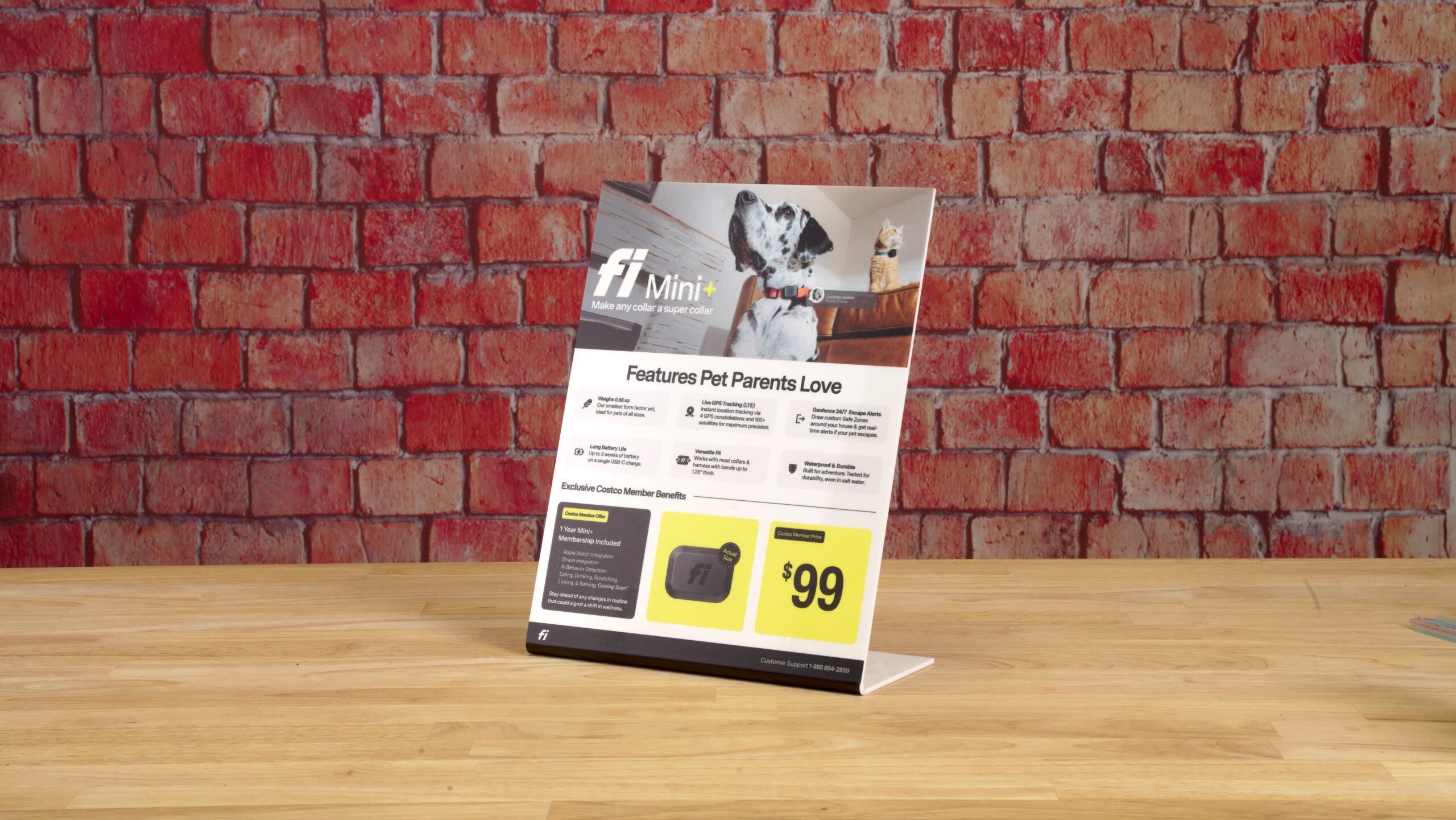
Custom point-of-purchase acrylic displays are strategically designed retail fixtures placed near decision points to influence buying behavior. Unlike standard shelving, these displays interrupt shopping patterns and deliver targeted brand messages at the exact moment consumers make purchase decisions.
How Do Custom POP Displays Differ From Standard Shelving And Generic Fixtures?
Custom POP displays outperform standard fixtures by actively engaging shoppers. Standard shelf displays achieve only 2.1% conversion rates, while custom acrylic edge-lit displays reach 8.3%, nearly 4x higher performance.
| Aspect | Custom POP Display | Standard Shelving | Impact on Conversion |
| Branding Flexibility | Full customization of colors, shapes, logos | Limited branding space | 3-4x higher brand recall |
| Message Visibility | Eye-level with integrated lighting | Competes with surrounding products | Captures attention in 2-3 seconds |
| Interrupting Flow | Breaks routine paths | Fixed in standard locations | 40-60% dwell time increase |
| Promotional Ability | Dedicated space for offers | No promotional emphasis | 2-3x impulse purchase increase |
| Measurement | Isolated for A/B testing | Hard to separate performance | Clear ROI justification |
What Main Types Of Custom POP Displays Can Brands Use (Floor, Endcap, Counter, Digital)?
Performance varies by display type: Interactive digital (7.1%), custom edge-lit (8.3%), basic acrylic countertop (5.2%), cardboard POP (3.8%).
- Floor Stands: 48-72" tall, high-traffic placement, best for launches and seasonal promotions
- Endcaps: Premium aisle-end placement, 3-5x attention vs. mid-aisle, ideal for impulse categories
- Counter Units: Compact checkout displays, capitalize on wait time, best for small impulse items
- Aisle Interrupters: Shelf-attached, eye-level (48-60"), best for samples and attention-grabbing
- Digital Screens: Dynamic content, motion attracts attention, best for complex products
Where In The Shopper Journey Do POP Displays Usually Influence Purchase Decisions?
Research shows 60-80% of purchasing decisions are made in-store, making POP displays critical intervention points:
- Entry: Capture attention, set shopping agenda
- Browsing: Break navigation patterns, create consideration
- Comparison: Highlight differentiators when intent forms
- Decision: Provide a last-moment nudge near category shelves
- Checkout: Drive add-on purchases during wait time
Why Do Custom POP Displays Matter For Converting Browsers To Buyers?
Custom POP displays transform shelf space into active sales tools through retail conversion design principles. They capture attention, communicate value instantly, and trigger decisions when shoppers are most receptive.
How Do POP Displays Tap Into Shopper Psychology And Impulse Buying?
Consumers spend only 2-3 seconds evaluating displays. Color influences 85% of purchasing decisions, triggering emotional responses before rational evaluation. Effective displays leverage scarcity messaging ("Limited Time"), social proof (ratings), anchoring effects (sale vs. regular price), and pattern interruption through unusual shapes or lighting.
Which Conversion Metrics Show Whether A POP Display Is Actually Working?
A 1% increase in dwell time leads to 1.3% rise in sales conversion.
| Metric | How to Measure | What It Tells You |
| Conversion Rate | Sales data vs. foot traffic | Are browsers becoming buyers? |
| Lift vs. Control | Test stores vs. control stores | True incremental impact |
| Dwell Time | In-store analytics, sensors | Early interest indicator |
| ROI | (Incremental profit - display cost) / cost | Financial justification |
How Do POP Displays Support Brand Awareness, Trial, And Trade-Up Behavior?
Brand recall ranges from 32% (no lighting) to 85% (color-changing LED), integrated lighting more than doubles awareness. Displays drive three pathways: Awareness through repeated exposure and premium fabrication, Trial by reducing barriers with samples and trial sizes, Trade-up by positioning premium products at eye level with clear benefit differentiation.
How Should You Define The Goal And Target Shopper For A POP Display Before Designing It?
Strategic design begins with clarity about objectives and audience. This foundation determines every design choice, essential merchandising display best practices.
What Questions Should You Ask To Clarify The Display's Primary Conversion Objective?
- What specific sales target justifies investment (units, revenue, margin)?
- Are we driving trial or repeat purchase? Volume or share-steal?
- Is pricing the driver or product features? Include sampling or coupons?
- What baseline metrics exist? Which KPIs determine success?
- What's the decision threshold for scaling or discontinuing?
How Can You Profile The Ideal Shopper And Their Decision Triggers At The Shelf?
Profile beyond demographics to capture decision patterns. Consider shopping mission (stock-up vs. impulse), category barriers (price, unfamiliarity, skepticism), and triggers (sensory cues, social proof, scarcity). The shopper buying premium coffee differs from one buying batteries.
Which Retailer Constraints And Category Norms Should You Capture Up Front?
- Footprint limits: Maximum dimensions, weight restrictions, clearance requirements
- Safety rules: Stability requirements, material restrictions, and electrical safety
- Merchandising rules: Brand blocking policies, space allocation, planogram compliance
- Setup requirements: Assembly ease, restocking frequency, lifespan expectations
Which Core Design Elements Most Directly Turn Browsers Into Buyers On POP Displays?
Edge-lit LED displays achieve 8.3% conversion, eye-level placement (48-60") maximizes visibility, and strategic lighting doubles brand recall. These elements consistently outperform all others through proven acrylic display lighting ideas and store fixture optimization.
How Can You Use Visual Hierarchy To Guide The Eye From Discovery To Decision?
Eye-level placement at 48-60 inches maximizes visibility. Visual hierarchy orchestrates information processing:
- Primary (Headline): Bold benefit statement, largest type, captures attention in 2-3 seconds
- Secondary (Product/Benefit Image): Hero shot or lifestyle context, creates desire
- Tertiary (Price/Offer): Prominent pricing with savings, removes objection
- Supporting (Details): Features, certifications, proof points, answers questions
How Do Color And Contrast Help Your POP Display Stand Out And Set The Right Mood?
- Match brand palette but contrast with category norms
- Use high-contrast pairs (black/white, navy/yellow) for 5+ feet readability
- Warm colors (red, orange) create urgency; cool colors (blue, green) convey trust
- Limit palette to 3-4 colors maximum; avoid low-contrast combinations
How Should You Choose Typography For Fast, Readable, And On-Brand POP Messaging?
Headlines limited to 5-7 words. Readable from 3-5 feet minimum. Headlines 2-3 inches for countertop displays.
- Maximum 2 font families; use weight variations for hierarchy
- Sans-serif fonts (Helvetica, Gotham) perform best at a distance
- Counter displays (3-5 ft): Headlines 2-3", body 0.5" minimum
- Floor stands (6-10 ft): Headlines 4-6", subheads 1-2"
How Can You Craft Headlines And Benefit Copy That Answer "What's In It For Me?" Instantly?
Shoppers engage within 2-3 seconds. Use benefit-first formulas:
- Problem-Solution: "Tired Skin? Wake It Up"
- Benefit-First: "Whiter Teeth in 3 Days"
- Save Messaging: "Save $5 Today"
- Speed/Convenience: "Dinner Ready in 10 Minutes"
Avoid: Generic claims like "Revolutionary Technology" or "Experience the Difference"
How Do Product Photography, Icons, And Lifestyle Imagery Reduce Shopper Hesitation?
- Hero Product Shot: Isolated on a clean background, showing the exact shelf appearance
- Usage Shot: Demonstrates application, answers "how do I use this?"
- Lifestyle Imagery: Creates emotional connection, helps visualize ownership
- Icons: Certifications (organic, gluten-free), benefit badges (high protein)
- Before/After: Shows transformation, best for visible results
How Should You Structure The 3D Form And Shape Of A Pop Display To Maximize Stopping Power?
- Angled Headers: 10-15 degree tilt toward traffic increases visibility from 20+ feet
- Tiered Shelving: Stepped levels bring rear products into view, creating a good-better-best layout
- Side Wings: Capture peripheral vision, provide multiple message surfaces
- Custom Shapes: Curved surfaces and brand-specific forms command longer dwell time
How Can You Use Materials, Finishes, And Sustainability Cues To Influence Perceived Value?
Acrylic offers the lowest annual cost ($11/year) despite a moderate initial investment. Cast acrylic is 15-30% more expensive than extruded but delivers 92% light transmission and superior durability.
| Material | Initial Cost | Annual Cost | Lifespan | Best Use Cases |
| Cardboard | $15 | $60/year | 3 months | Temporary promotions |
| Extruded Acrylic | $50 | $25/year | 2-3 years | Semi-permanent, mid-market |
| Cast Acrylic | $85 | $11/year | 5-10 years | Permanent, luxury brands |
| Metal | $250 | $17/year | 15+ years | Heavy products, security |
How Can Lighting, Motion, And Digital Screens Amplify Attention Without Causing Overload?
Custom edge-lit displays achieve 8.3% conversion, 60% higher than basic acrylic (5.2%). Brand recall jumps from 32% (no lighting) to 85% (color-changing LEDs). Acrylic's 92% light transmission enables dramatic edge-lighting and backlighting effects.
- Static Lighting: Always-on visibility, low energy, creates premium perception
- Animated Elements: Captures peripheral vision, slow pulse (1-2 sec), more effective than rapid flash
- Digital Screens: 7.1% conversion underperforms premium acrylic (8.3%), high cost ($500-2000+)
How Can You Reduce Friction With Ergonomics, Reachability, And Easy Product Access?
Products at eye level (48-60") see significantly higher engagement. Remove physical barriers:
- Height by Type: Countertop (36-42"), floor stands (40-60"), checkout (30-36")
- Reach Distance: Maximum 24" forward, 18" to sides without leaning
- Shelf Depth: Under 18" to prevent dead zones; 2" clearance for finger access
- ADA Compliance: One facing at 15-48" height, 36" front clearance
How Should You Adapt POP Display Design For Different Retail Channels And Locations?
ROI varies by category: Luxury (425%), cosmetics (380%), fashion (310%), electronics (220%), pharmacy (185%), grocery (145%). Channel-specific behaviors demand tailored strategies.
How Does POP Display Design Change Between Grocery, Mass, Drug, And Convenience Stores?
| Channel | Shopper Mission | Display Constraints | Best Types | Conversion Opportunities |
| Grocery | Weekly stock-up | Large footprint (4-6 sq ft) | Floor stands, endcaps | Cross-sell bundles, bulk sizes |
| Mass Retail | Comparison shopping | Medium (2-4 sq ft) | Modular stands, seasonal | Trading up to premium |
| Drug/Pharmacy | Health-focused, quick trips | Small (1-2 sq ft) | Counter displays | Complementary health items |
| Convenience | Grab-and-go | Minimal (<1 sq ft) | Compact counter units | Impulse snacks, beverages |
| Specialty | Destination shopping | Medium (2-3 sq ft), premium | Premium acrylic, demos | Education, accessory attachment |
How Should You Tailor POP Displays For Endcaps, Aisle Interruptors, Checkout, And Power Aisles?
- Endcaps: 48-72" tall, three-sided graphics, promotional pricing focus
- Aisle Interruptors: 6-12" projection, eye-level, impulse items, and add-ons
- Checkout: 8-12" tall compact units, "while you wait" messaging
- Power Aisles: 60-72" tall, visible 30+ feet, seasonal campaigns
- Category Adjacency: Small stands at category edge, cross-merchandising bundles
How Can Branding And Storytelling In POP Displays Build Trust And Long-Term Loyalty?
Effective displays balance immediate conversion with brand-building. Strategic displays reinforce core values while driving today's sales.
How Do You Keep POP Displays Consistent With Core Brand Assets And Campaign Platforms?
- Match exact PMS colors from brand standards
- Use approved logo files with proper clearance space
- Maintain brand's tone of voice (luxury avoids ALL CAPS; value brands embrace urgency)
- Include signature design elements from packaging
- Coordinate with TV and digital campaigns for unified messaging
How Can You Use Micro-Stories, Use-Case Scenarios, And Social Proof On POP Displays?
- Hero Scenarios: Brief problem-solution vignettes ("Spilled Coffee? Cleaned in Seconds")
- Before/After: Side-by-side transformation with timeframe ("After Just 2 Weeks")
- Testimonials: Real customer quotes, 10-15 words maximum
- Ratings: Star ratings with source ("Rated 4.8 on Amazon")
- Media Logos: "As Seen In" credibility, 3-4 maximum
How Should You Localize POP Displays For Seasons, Regions, And Store Demographics?
- Seasonal: Holiday-specific creative, weather-appropriate context, 8-12 week lead time
- Regional: Food preferences by region, sports team tie-ins, climate-appropriate positioning
- Demographic: Urban (smaller packages), suburban (family sizes), senior-dense (larger type)
- Retailer-Specific: Premium retailers (elevated aesthetic), value retailers (savings-focused)
Designing Custom POP Displays That Convert Browsers To Buyers
Effective custom POP displays can significantly boost conversions, with edge-lit LED units delivering 8.3% conversion versus 2.1% for standard shelving and integrated lighting doubling brand recall. To turn this into a repeatable playbook, start by defining clear objectives (trial, trade-up, or volume), designing shopper-first layouts with strong visual hierarchy, choosing efficient materials like cast acrylic for long-term displays, positioning products at 48–60 inches, embedding measurement (conversion, dwell time, ROI), and tailoring designs to each channel. When budgets are tight, prioritize high-impact, low-cost updates first: integrate lighting, move products to eye level, strengthen CTAs, and improve pricing visibility.
Next, tackle moderate-cost upgrades such as refreshing typography, improving product photography, and shifting placement to high-traffic zones like endcaps or checkouts. Longer term, invest in premium materials, custom 3D structures, and full-program rollouts. Finally, scale success with retail partners through data-backed co-planning, shared KPIs, structured pilot tests, standardized rollout toolkits, and ongoing quarterly optimization to sustain performance across stores.
Ready to design custom POP displays that convert browsers into buyers? From eye-catching brochure holders to full merchandising solutions, contact our team at Displays and Holders to discuss your project and discover how strategic display design can drive measurable sales improvements for your brand.