











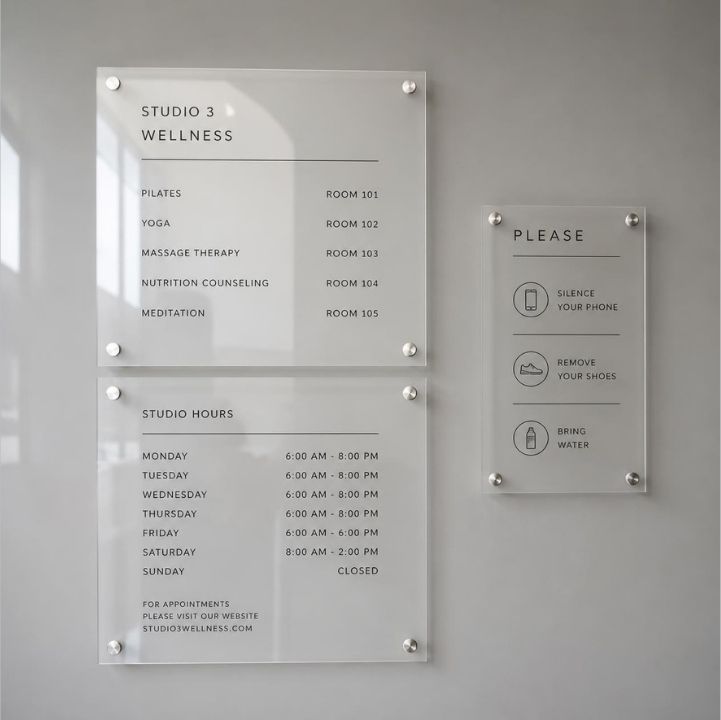
A literature wall organizes every brochure, flyer, and handout in one place, using wall-mounted and slatwall display systems built for daily traffic. Getting it right takes more than picking a fixture off the shelf. Mounting height, wall substrate, ADA code, and load capacity all shape whether the wall performs or fails. Complement your literature wall with our purpose-built custom display sign holders to tie directional cues, headers, and category labels into a unified system designed around your exact space and branding.
Below, you'll find what matters at each step: choosing a display system, matching it to your wall, meeting accessibility requirements, and managing load safely. Follow it and your literature wall stands up to years of daily use.
Key Takeaways
- Slatwall offers the most flexibility. Its groove pattern lets you reposition fixtures fast, without new holes, making it the strongest choice for testing layouts and adapting over time.
- Find the stud before you mount anything heavy. A wood screw into a stud holds roughly twice what the strongest hollow-wall anchor holds in gypsum board alone.
- Mount literature pockets within the 40"-48" ADA band. That range meets code and lands close to natural eye height, so compliance and visibility work together, not against each other.
- Vertical position matters more than horizontal position. Moving a fixture up or down the wall drives roughly 2.5 times more sales impact than moving it side to side.
- Load safety comes down to distance and placement. Shorter hooks carry more weight, and heavy items belong at the panel's centerline, away from exposed edges where failure happens without warning.
What is a Literature Wall and Why Use One?
A literature wall keeps every brochure, flyer, and handout in one place. It replaces scattered stacks on counters and desks with one organized fixture. Customers find what they need. Staff spend less time restocking loose piles.
A Literature Wall Is a Wall-Mounted System of Organized Pockets
A literature wall holds multiple pocket displays on a single wall-mounted fixture. Each pocket holds one type of printed brochure or literature material. Customers browse and take what they need without asking staff. The wall turns scattered paperwork into a clean, branded information point. It works for any business that hands out printed materials on a regular basis.
Literature Pockets Come in Three Standard Sizes
Pocket size matches collateral size. Three formats cover most business needs.
| Format | Nominal Size | Pocket Width | Capacity |
| Tri-fold brochure / rack card | 4" x 9" | 4" wide pocket | ~75 sheets |
| Half-page flyer | 5.5" x 8.5" | 5.5" wide pocket | — |
| Full page / letter document | 8.5" x 11" | 8.5" wide pocket | ~96 sheets |
Match the pocket to the collateral. A pocket too large lets paper slide and curl. A pocket too small won't hold enough stock between refills.
Literature Walls Fit Anywhere Customers Need Information on Their Own Time
Literature walls work well where customers browse without staff assistance. Reception areas and waiting rooms use them for forms and service information. Retail stores use them near checkout for promotions and product guides. Trade shows, real estate offices, and professional practices use them for pricing sheets, listings, and handouts without tying up staff. Any business with recurring printed materials and limited staff time benefits from one. Our simple-to-mount wall mounted brochure holders make it easy to build a literature wall in any of these settings, keeping materials organized and accessible without taking up valuable counter or floor space.
What Wall Display Systems Support Literature Walls?
Five mounting systems can carry literature pockets. Each has different strengths for cost, flexibility, and load capacity. The right system depends on how often you'll reconfigure the wall and what else you'll hang on it.
Five Systems Mount Literature Walls: Slatwall, Gridwall, Pegboard, Slotted Standard, and Rail
Each system anchors to the wall differently and holds fixtures in a different way.
- Slatwall: Grooved panels with T-slot bottoms. Screwed into studs or captured in side channels.
- Gridwall: Wire grid mounted on brackets or free-standing legs.
- Pegboard: Panel mounted on furring strips. Hooks fit into drilled holes.
- Slotted standard & bracket: Vertical standards anchored into studs. Brackets clip in at any height.
- Rail/cleat: Horizontal rail anchored into studs. Fixtures hang directly from the rail.
Slatwall and slotted standard offer the most adjustability. Pegboard and rail systems cost less but adjust less.
Slatwall Wins on Position Flexibility, Which Drives More Sales Than Facing Count
Position matters more than quantity. A couple of facings at eye level can outsell five facings on the bottom shelf. In the Drèze study, optimizing position alone delivered +10% profit. Optimizing facing count alone delivered only +3%.
Pocket Slatwall's groove pattern makes repositioning fast. Move a hook or pocket to a new groove in seconds, no new holes required. That flexibility also applies to browsability: easier scanning can lower sales, and harder scanning can raise them (see "The Tension Between ADA Limits and Peak Sales Heights" below). Combined with its long service life (see below), that flexibility pays for itself twice: in merchandising agility and in avoided lease-end restoration cost.
Slatwall Lasts at Least 10 Years and Removes Cleanly at Lease End
Slatwall holds up for the length of a typical commercial lease. Industry expectation puts its service life at 10 years or more.
Removal is simple. Panels come down, anchors come out, and the wall gets skimmed and repainted for turnover. Budget for that labor and material cost using current rates: RSMeans reports a 4.1% year-over-year increase in labor rates for 2025, and a 3.1% increase in materials.
How Does Wall Substrate Affect Literature Wall Installation?
The wall behind your fixture determines how much weight it can safely hold. Gypsum board, wood studs, steel studs, and concrete each carry different loads. Know your substrate before you mount anything.
Wall Substrate Sets the Load Ceiling Before You Pick Hardware
Most interior walls use gypsum board over wood or steel framing. Standard thicknesses run ½" or ⅝". ASTM C473 sets a minimum nail-pull resistance of 77 lbf for ½" gypsum board — a baseline for how much the board itself resists pulling loose.
Framing behind the board matters just as much. Wood studs typically run 2×4 or 2×6, spaced 16 inches on center. Steel studs in non-load-bearing partitions typically run 25 gauge. Studs carry far more weight than the gypsum board alone, which is why locating them matters before mounting anything heavy.
Anchor Capacity Varies Sharply by Substrate and Anchor Size
Anchor ratings come in two numbers: ultimate load (the breaking point) and allowable load (the safe working limit, typically ultimate divided by a 4:1 safety factor). Bigger anchors and denser substrates both raise capacity.
| Anchor | Substrate | Ultimate Load | Allowable Load |
| ¼"-20 SNAPTOGGLE | ½" gypsum | 265 lb | 66 lb |
| SNAPTOGGLE BA | ½" gypsum | 238 lb | 60 lb |
| SNAPTOGGLE BB | ⅝" gypsum | 356 lb | 89 lb |
| SNAPTOGGLE BE | ⅝" gypsum | 480 lb | 120 lb |
| SNAPTOGGLE BC | ⅝" gypsum | 576 lb | 144 lb |
| SNAPTOGGLE BB | Concrete block | 1,080 lb | 270 lb |
Substrate changes the outcome more than anchor choice does. The same anchor holds far more in concrete than in gypsum board.
A Wood Stud Beats the Best Hollow-Wall Anchor
Screwing into a stud outperforms any hollow-wall anchor. A #10 wood screw into Douglas Fir-Larch holds 135 lb allowable per inch of thread penetration. A #12 wood screw at 1" penetration holds 154 lb allowable. That's roughly double the capacity of the strongest common hollow-wall anchor at a comparable fastener size.
Gypsum board alone has real limits. Even the strongest hollow-wall anchor in ½" gypsum tops out at roughly one-third of what it holds in concrete block. Find the stud whenever the wall unit carries meaningful weight. Use a rated anchor only when a stud isn't available.
What Accessibility and Code Constraints Impact Literature Walls?
ADA rules govern where you can mount a literature wall, not just how. Reach range and protrusion limits both apply. Miss either one and the fixture is non-compliant, even if it looks fine.
ADA Requires Literature Pockets to Sit Within a 40" to 48" Reach Band
Any operable part — anything a customer must grasp, pinch, or pull — has a maximum height of 48 inches above finish floor (AFF). The low reach minimum is 15 inches AFF. That gives a compliant window of roughly 40" to 48" for literature pockets, an 8-vertical-inch band. High forward reach, obstructed or unobstructed, tops out at the same 48" ceiling.
Pocket Depth Stays Within the Protrusion Limit; Deep Faceouts Often Don't
Fixtures mounted between 27" and 80" AFF can protrude no more than 4 inches into the walking path. Published acrylic pocket depths run 1.57 to 3.0 inches, comfortably inside that limit. A typical slatwall faceout runs 12 inches or more, two to four times over the limit. Choose shallow pocket-style fixtures over deep faceouts wherever ADA clearance is a factor.
Peak Sales Height Sits Above the ADA Ceiling, So Code Wins the Trade-Off
The peak-selling shelf zone, per Drèze et al., runs 51 to 53 inches. That's above the 48" ADA ceiling for operable parts, an unresolved 3-5 inch gap between peak sales performance and what code allows. Chen et al. found peak visual attention at a different zone, 44-49 inches, and the two studies don't agree on which zone performs strongest.
The gap matters because grasping changes the rule. A sign holder is read, not grasped, so it isn't capped at 48". A literature pocket is grasped and removed, so it is. Height still moves the needle even within compliant range: relocating toothbrushes from 72" to 56" lifted sales 8% and category profit 11%. Mount literature pockets as high as the 40"-48" band allows.
How Do Mounting Height and Placement Influence Engagement?
Placement research backs up the ADA math from the last section. Eye height and viewing angle explain why the 40"-48" band performs well. Vertical position also matters more than horizontal position, by a wide margin.
Natural Eye Height Puts the Compliant Zone in the Right Sightline
Average eye height runs 59 inches for US females and 64 inches for US males. The preferred viewing angle, per Eastman Kodak research from 1983, sits 15° below horizontal. That angle points straight into the low-to-mid shelf zone, close to the ADA-compliant 40"-48" band. Mounting within code range isn't a compromise. It lands close to where people naturally look.
The underlying research is substantial: a Drèze et al. study spanning 60 stores, 16-week test windows, and 86-99 week baselines.
Making Browsing Easier Doesn't Always Raise Sales
Easier navigation can backfire. Alphabetizing canned soup cut sales 6%. Reorganizing cereals by type cut sales 5%. Separating bath tissue pack sizes by 12 feet, making comparison harder, raised category sales and profit 5%. A cluttered scan sometimes sells more than a tidy one. Test layout changes before assuming "clearer" means "better."
Vertical Position Outsells Horizontal Position by 2.5 Times
Where a product sits top-to-bottom matters far more than where it sits left-to-right. Moving from the lowest to the highest vertical position lifted unit sales 39% on average. The same move horizontally lifted sales only 15%. Vertical position is roughly 2.5 times more valuable.
Category results back this up:
- Cereals: +5% horizontal, +100% vertical, +112% combined
- Refrigerated juices: +22% horizontal, +69% vertical, +108% combined
- Analgesics: +11% horizontal, +19% vertical, +32% combined
Prioritize height over horizontal spread when placing a literature wall or any merchandising fixture. Getting the vertical position right does more work than getting the horizontal position right.
What Should Be Considered When Planning Slatwall for Literature Walls?
Slatwall specs determine how much weight the wall holds and how precisely you can position fixtures. Panel construction, groove spacing, and accessory selection all factor into the plan. Get these right before installation, not after.
Panel Thickness and Insert Type Set the Load Ceiling
Standard slatwall panels run 4' × 8' (48" × 96"), at a standard thickness of ¾ inch (0.750" ± 0.005"). A full panel weighs 85-86 lb before any hardware goes on.
Insert material drives capacity more than panel size does. Adding an aluminum insert to a 120 psi MDF board raises breaking load by 90%. Upgrading the MDF itself from 120 psi to 150 psi adds another 18%. For heavier literature displays, specify aluminum-inserted panels rather than relying on MDF alone.
Groove Spacing Determines How Precisely You Can Position Fixtures
Standard groove spacing runs 3 inches on center. On a 96" tall panel, that yields 32 possible accessory heights. Halving the pitch doubles the usable heights, giving finer control over vertical placement — which matters given how much vertical position affects engagement (see previous section).
Installation hardware is predictable: a 4×8 panel takes roughly 43 screws. A standard 1,000-screw box installs about 23 panels.
Match Accessory Type to Load and Merchandising Density
Accessory choice depends on what the pocket needs to hold and how densely you want to merchandise.
| Accessory | Sizes | Carton Qty |
| Straight hooks | 1", 4", 6", 8", 10", 12" | 100 |
| Rectangular faceout | 12" | 25 |
| Waterfall | 14" (5-hook), 16" (6-ball) | 25 |
| Knife shelf brackets | 8", 10", 12", 14" | 50 |
Unsupported slatwall area itself carries roughly 25 lb per square foot. Plan accessory placement around that ceiling, especially on panels without aluminum inserts.
How to Manage Load and Safety on Literature Walls?
Load capacity depends on more than the anchor rating on a spec sheet. Hook length, safety factors, and placement on the panel all change how much weight a fixture can safely carry. Get these wrong and failure happens without warning.
Shorter Hooks Carry More Weight Than Longer Ones
Load capacity depends on distance, not just weight. Moment equals load times distance, measured in foot-pounds. A load at the end of a hook multiplies by the full hook length. A load spread evenly along a prong multiplies by half the prong length instead.
Distance changes capacity fast. A 12" hook holds 59 lb working load. A 6" hook, half the distance, holds 118 lb — double the capacity. Choose the shortest hook that does the job.
Safety Factors Cut Rated Capacity Well Below the Breaking Point
Every load rating includes a buffer. Ultimate load is the breaking point, the load at which the anchor or panel actually fails. Allowable load is the safe working limit, calculated by dividing ultimate load by a safety factor.
Standards vary by material and industry. Toggler rates hollow-wall anchors at a 4:1 safety factor. Simpson Strong-Tie rates masonry anchors under the IBC at 5:1. Panel Processing caps slatwall panel working load at 66% of breaking load. Always design to the allowable or working number, never to the ultimate rating.
Slatwall Fails Suddenly, So Load Placement Matters More Than It Looks
Slatwall doesn't sag or creak before it fails. Panel-face segments can pop off suddenly, with no warning sign beforehand.
Placement determines risk. Loads near an exposed panel edge compromise capacity significantly — never load slatwall near an exposed edge. Place heavy items at the panel's left-right centerline, roughly 8 inches from either edge, where the panel is strongest.
Planning and Implementing Your Literature Wall for Business Success
The research points to a short list of decisions. Get these right, and the wall performs well for years.
- Mount within the ADA band. Keep every pocket in the 40"-48" compliant range established earlier.
- Pick pocket depth carefully. Shallower pockets keep a cleaner face but need more frequent restocking.
- Plan for the unknown. Stock 8.5"×11" pockets with dividers to handle collateral sizes not yet finalized.
- Keep weight low and centered. Heavy merchandise belongs low on the wall, away from exposed edges, for structural and commercial reasons alike.
- Fasten into every stud. With 16" stud spacing and a 3" groove pitch, that lands roughly every fourth or fifth groove.
Follow these five points and the literature wall holds its load, meets code, and keeps working long after installation.
Build Your Literature Wall with Displays & Holders
Displays & Holders has manufactured acrylic display solutions in Anaheim, California since 1986. Over 100,000 businesses trust us for literature pockets, slatwall accessories, and custom mounting solutions built to hold up for years. Custom orders start at just 50 units, and in-stock items ship same-day when ordered before 2 PM PST.
Ready to plan your literature wall? Call us at 714-527-1179 or request a quote today. Our team will help you choose the right pocket sizes, mounting system, and hardware for your space.
Frequently Asked Questions
Q1. What size literature pocket fits a standard brochure?
A. A standard tri-fold brochure or rack card measures 4" x 9" and fits a 4" wide pocket. Half-page flyers need a 5.5" wide pocket, and full letter-size sheets need an 8.5" wide pocket. Match the pocket to the collateral size so paper doesn't slide, curl, or jam during restocking.
Q2. How high should I mount a literature wall for ADA compliance?
A. Mount literature pockets between 40" and 48" above finish floor. That range meets the ADA reach requirement for operable parts and sits close to natural eye height for most adults. Mounting outside that band, even by a few inches, puts the fixture out of compliance.
Q3. What's the difference between slatwall and gridwall?
A. Slatwall uses grooved panels with a T-slot design, anchored into studs or side channels. Gridwall uses a wire grid on brackets or free-standing legs and costs less, but adjusts in larger increments. Choose slatwall for frequent layout changes, gridwall for simpler needs.
Q4. How much weight can a slatwall panel hold?
A. Unsupported slatwall area carries roughly 25 lb per square foot. Adding an aluminum insert to a standard MDF panel raises breaking load by about 90%. Actual capacity also depends on hook length and edge distance, so design to the panel's rated working load, not its breaking point.
Q5. How long does a slatwall literature wall last?
A. Industry expectation puts slatwall service life at 10 years or more, covering a typical commercial lease term. It also removes cleanly at lease end: panels come down, anchors come out, and the wall gets skimmed and repainted. That durability and clean removal make it a low-risk tenant improvement.