










Key Takeaways:
- Acrylic leads in optical clarity at 92% light transmittance and maintains 90% clarity after 30 years, making it ideal for premium displays.
- Polycarbonate delivers unbreakable durability with 200x glass impact strength but costs $3.50/kg and scratches easily without coating.
- Material costs range from $1.20/kg (polystyrene) to $3.50/kg (polycarbonate), but long-term value depends on replacement frequency and environment.
- Scratch resistance favors acrylic (Rockwell M 94-105) over polycarbonate (Rockwell M 70-75), affecting appearance in high-touch applications.
- PETG offers balanced performance at $2.25/kg with 5-7x acrylic's impact strength and excellent chemical resistance for versatile applications.
Material selection impacts clarity, durability, maintenance costs, and brand perception. The wrong choice leads to premature replacement, cloudy displays, and damaged brand image. The right material delivers years of service while maintaining professional appearance. This guide compares acrylic against polycarbonate, PETG, and polystyrene across critical performance metrics. You'll discover which materials excel in retail, hospitality, corporate, and trade show applications based on quantitative data rather than marketing claims.
What Are Acrylic Sign Holders and How Are They Made?
Acrylic sign holders represent the premium standard in professional displays. Material properties and fabrication methods determine final product quality.
How Is Acrylic Fabricated for Professional Displays?
Manufacturers produce acrylic holders through injection molding, thermoforming, and CNC machining. Standard thickness ranges from 1/10 inch (0.100 inches) to 3/16 inch (0.1875 inches) for larger frames. Fabrication method affects edge quality, dimensional accuracy, and production cost. Injection molding suits high-volume production with consistent tolerances. Thermoforming works well for complex curves and shapes. CNC machining delivers precision for custom one-off projects. For precise specifications, understanding cast vs. extruded acrylic differences ensures optimal custom printed displays.
What Properties Make Acrylic Clearer Than Standard Plastic?
Acrylic delivers 92% light transmittance, exceeding glass and all transparent plastics. Clear-transparent acrylic retains 90% light transmission after 30 years of outdoor exposure. This longevity stems from inherent UV resistance with only 3% degradation over 10-year outdoor periods.
Why Do Businesses Use Acrylic for Retail and Corporate Signage?
Acrylic combines optical clarity with UV stability and balanced mechanical properties. Natural UV resistance prevents degradation common in other plastics. Businesses choose acrylic when professional appearance directly impacts brand perception. The material suits both temporary campaigns and permanent installations. Premium appearance justifies higher costs in customer-facing applications where display quality influences purchasing decisions.
What Are Plastic Sign Holders and What Materials Are Used?
Five plastics dominate the market: PET, PETG, polycarbonate (PC), polystyrene (PS), and acrylic (PMMA). Each offers specific advantages for different applications.
What Types of Plastic Are Common in Sign Holders?
Polycarbonate maintains stability at temperatures up to 135°C with 86-90% light transmission. Polystyrene provides 88-90% clarity at lowest cost but lacks durability. PETG delivers excellent clarity similar to acrylic with superior flexibility. PET operates across -60°C to 130°C temperature ranges. Polystyrene comes in 0.080", 0.098", and 0.118" thicknesses.
How Are Plastic Sign Holders Manufactured?
Thermoplastic fabrication uses injection molding, thermoforming, and extrusion. PETG fabricates easily and resists chemicals during processing. Manufacturing flexibility affects customization options and minimum order quantities.
Where Are Plastic Sign Holders Most Commonly Used?
Polystyrene suits disposable holders where durability isn't critical but fails outdoors due to poor UV resistance. Polycarbonate excels in high-traffic or harsh environments. PETG serves versatile applications needing impact resistance beyond acrylic capabilities.
What Are the Core Material Differences Between Acrylic and Plastic?
How Does Optical Clarity Compare?
Acrylic leads at 92% transmittance. PETG follows at 90%. Polystyrene reaches 89%. Polycarbonate delivers 88%. Glass achieves 91% for reference. The 4% difference between polycarbonate and acrylic affects perceived quality in premium applications where every detail matters. Higher transmittance means brighter, more vibrant displayed content that captures attention. These differences become apparent in side-by-side comparisons under identical lighting conditions. Retail environments with controlled lighting showcase acrylic's superior clarity advantage. Office environments with mixed natural and artificial light benefit from maximum light transmission.
Which Material Is More Rigid and Structurally Stable?
Acrylic exhibits rigidity but brittleness with tensile strength of 65-83 MPa. PETG offers superior flexibility, reducing brittleness-related failures. PET delivers higher strength and better strength-to-weight ratios than HDPE.
How Does Impact Resistance Differ?
Polycarbonate dominates with 200 times glass strength and 30 times acrylic strength. PETG reaches 85 times glass strength (5-7 times acrylic). Acrylic achieves 17 times glass strength. Polystyrene fails under minimal impact. These multipliers translate directly to real-world durability expectations. A dropped item shatters polystyrene, cracks acrylic, and bounces off polycarbonate without damage. High-traffic environments demand materials above 50x glass strength to prevent frequent replacement. Shopping districts, healthcare facilities, and busy office lobbies require maximum impact resistance. Controlled environments with minimal traffic can use lower-impact materials cost-effectively.
Which Material Is More Scratch-Resistant?
Acrylic provides superior scratch resistance with Mohs hardness of 3-4 and Rockwell M scale of 94-105 versus polycarbonate at Mohs ~3 and Rockwell M 70-75. This 24-point Rockwell difference significantly affects long-term appearance under daily use. Everyday objects like keys scratch polycarbonate more readily than acrylic. Hard coating improves polycarbonate scratch resistance but increases material costs by 30-40%. Facilities requiring frequent cleaning benefit from acrylic's harder surface that resists micro-scratching. Display cases in jewelry stores, museums, and upscale retail demand maximum scratch resistance to maintain pristine appearance. Industrial environments may tolerate scratched surfaces if impact resistance takes priority.
How Do Thickness and Weight Compare?
PETG weighs 1.27 g/cc, polycarbonate 1.20 g/cc, and acrylic 1.19 g/cc. A 100-unit PETG shipment weighs approximately 7% more than identical acrylic units. Acrylic's water absorption ranges from 0.13-0.80.
How Do Acrylic and Plastic Perform in Real Business Environments?
Which Material Works Better in High-Traffic Retail Settings?
Polycarbonate's 200x glass impact strength withstands high-traffic areas where vandalism or damage occurs. Shopping carts, strollers, and customer handling create constant stress. Acrylic's superior scratch resistance (Mohs 3-4) maintains appearance through frequent handling and daily content updates. PETG balances both requirements with 5-7 times acrylic's impact strength while keeping excellent clarity. Premium retailers prioritize acrylic's 92% transmittance for product displays where color accuracy matters. Discount retailers may accept polycarbonate's 88% clarity for enhanced durability in demanding environments. Browse sign holders and ad frames for application-specific options.
What Is Best for Restaurant Tables, Menu Displays, and Hospitality Use?
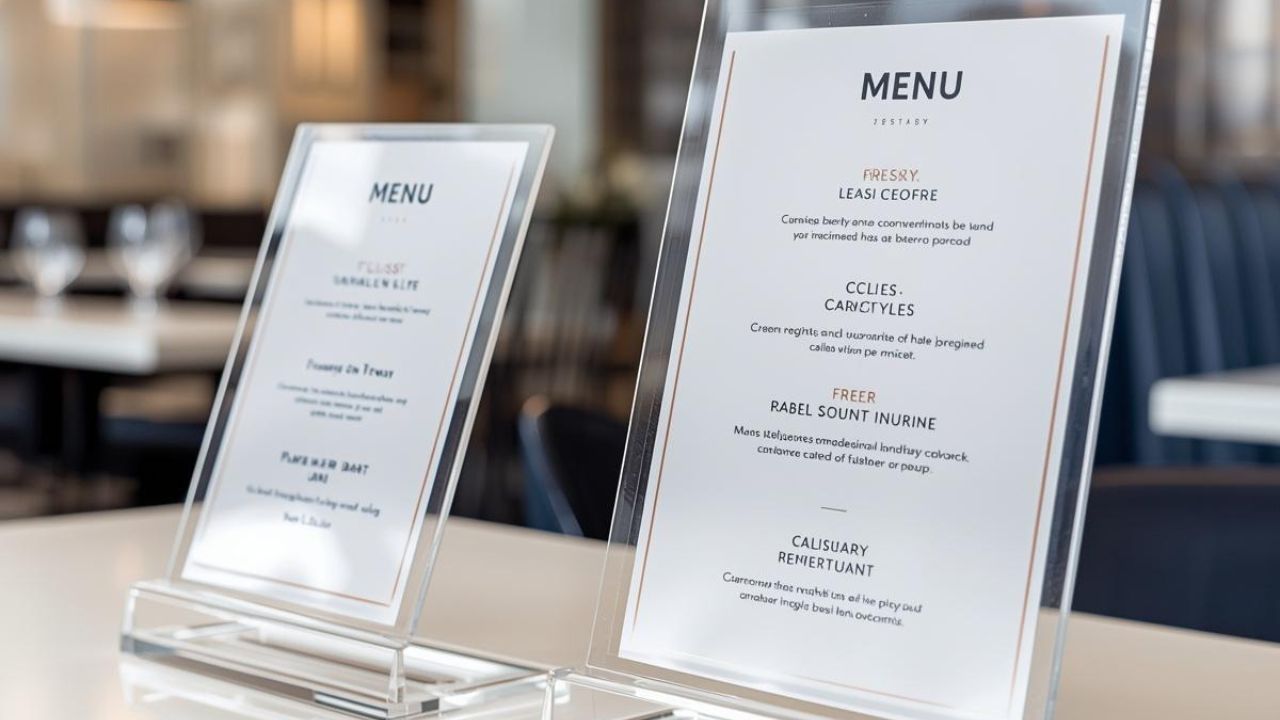
Menu holders accommodate multiple pages through ring binder mechanisms or acrylic sleeves. Table tents promote specials and events with double-sided visibility. Acrylic's 92% transmittance ensures maximum menu visibility in varied lighting conditions from dim romantic settings to bright cafe environments. The material resists common food service chemicals and cleaning solutions used in daily sanitization. PETG offers superior flexibility for high-volume establishments where drops occur frequently during busy service periods. Quick-service restaurants with high table turnover rates create constant stress on menu holders. Polystyrene suits single-use promotional campaigns for limited-time offers where replacement costs matter more than longevity.
Which Option Is More Suitable for Corporate Offices and Lobbies?
Slant-back holders present information at comfortable reading angles for reception desks. These configurations enhance visitor experience and reinforce professional brand image from the moment guests enter. Acrylic maintains 90% clarity after 30 years, ideal for permanent lobby installations that serve as brand ambassadors. Corporate decision-makers value consistency and minimal replacement frequency across multi-location operations. Polycarbonate serves high-traffic medical environments where impact resistance outweighs appearance concerns and frequent sanitization is mandatory. Hospitals, urgent care facilities, and dental offices prioritize durability and cleanability over aesthetics.
How Do Both Materials Perform at Trade Shows and Events?
Portability dominates trade show requirements. Lightweight, collapsible designs minimize setup time and shipping costs. Acrylic's 1.19 g/cc density keeps display systems portable. Single-event applications may use polystyrene for cost efficiency.
How Do Acrylic and Plastic Compare in Cost and Long-Term Value?
Is Acrylic More Expensive Upfront?
Polystyrene leads at $1.20/kg. PET reaches $1.50/kg. Acrylic ranges $1.75/kg. PETG costs $2.25/kg. Polycarbonate tops pricing at $3.50/kg. A letter-size acrylic holder costs 46% more than polystyrene but 50% less than polycarbonate.
Why Are Plastic Sign Holders Typically Lower in Cost?
Polystyrene's $1.20/kg cost makes it most economical. Material savings come with durability trade-offs including poor impact strength and limited UV resistance. High-volume production of commodity plastics reduces per-unit costs.
Does Acrylic Offer Better Long-Term Value?
Acrylic suffers only 3% degradation over 10 outdoor years with guaranteed 90% light transmission after 30 years. UV-stabilized acrylic maintains transparency far longer than standard sheets. Polystyrene requires replacement within months outdoors due to UV damage and brittleness. PETG's durability justifies its $2.25/kg cost through extended service life in demanding applications. A $10 acrylic holder lasting 10 years costs $1/year. A $6 polystyrene holder replaced annually costs $60 over the same period. Initial savings disappear quickly when replacement frequency enters calculations. Premium materials deliver superior total cost of ownership despite higher upfront investment.
How Do Bulk Orders Affect Pricing Differences?
Source One Displays offers free shipping over $100. Volume discounts and custom cut-to-size services reduce per-unit costs significantly across large orders. Bulk orders reduce percentage cost differences between materials that appear substantial at single-unit pricing. A 100-unit acrylic order may cost only 20% more than polycarbonate instead of 50% at single-unit pricing. Standardized dimensions across multiple locations simplify reordering and inventory management for multi-site operations. National chains benefit from consistent supplier relationships and predictable pricing structures. Businesses should calculate total program costs including shipping, setup time, and replacement frequency rather than focusing solely on individual unit prices. For custom requirements leveraging bulk pricing, explore custom display solutions.
What Should Businesses Consider Before Choosing Between Acrylic and Plastic?
How Important Is Professional Appearance and Brand Image?
Acrylic's 92% transmittance delivers the clearest, most professional appearance. Optical clarity influences customer perception of displayed information. Premium materials signal quality and attention to detail.
Will the Sign Holder Be Used Daily or Occasionally?
Acrylic's Mohs 3-4 scratch resistance suits daily handling. Polycarbonate's 200x glass impact strength handles heavy traffic and rough treatment. Occasional use reduces durability demands, potentially justifying lower-cost materials.
Does the Display Need to Last for Years or Short-Term Campaigns?
Acrylic maintains 90% light transmission after 30 years. Polystyrene serves disposable applications and temporary promotions. PETG offers 70% of polycarbonate's strength for medium-term campaigns. Short campaigns under three months may justify polystyrene despite poor durability.
Is Custom Printing or Fabrication Required?
Acrylic thickness ranges from 1/10" to 3/16" for different applications. PETG fabricates easily with excellent customization potential. Laser cutting, CNC machining, and edge polishing work best with acrylic.
Does Nationwide Reordering and Consistency Matter?
Standard dimensions ensure consistency across locations. Major manufacturers like Deflecto, Azar Displays, and Marketing Holders offer nationwide availability. Material specifications remain consistent for repeat orders.
Can Acrylic and Plastic Sign Holders Be Customized?
Which Material Supports Precision Laser Cutting and Polishing?
Acrylic excels in precision fabrication through CNC machining and laser cutting. Edge polishing achieves maximum effectiveness on acrylic, producing crystal-clear edges. Complex geometries and tight tolerances favor acrylic's stable machining characteristics.
Is UV Printing More Effective on Acrylic?
Acrylic's inherent UV stability prevents significant yellowing, ideal for UV printing applications. Only 3% UV degradation over 10 years maintains print quality and color accuracy throughout the display's lifetime. High-quality, UV-stabilized acrylic preserves print vibrancy longer than competing materials even under constant UV exposure. Polystyrene's poor UV resistance causes rapid print fading outdoors, sometimes within weeks of installation. Polycarbonate requires UV stabilizers to prevent yellowing that distorts printed colors and reduces brand impact. Print permanence affects whether graphics maintain impact throughout holder lifespan rather than fading prematurely. High-traffic locations with constant UV exposure from windows or outdoor placement demand UV-stable substrates for anti-glare and visual performance—learn more about anti-glare technologies.
Which Option Is Better for Branded or Logo Displays?
Acrylic's 92% transmittance showcases brand colors with maximum accuracy. Scratch-resistant surface (Mohs 3-4) keeps branded displays professional through years of use. Premium appearance aligns with corporate brand standards.
How Does Custom Sizing Compare Between Materials?
Business cards measure 85 x 55 mm (3.5 x 2 inches). Letter size is 216 x 279 mm (8.5 x 11 inches). Legal size extends to 216 x 356 mm (8.5 x 14 inches). A4 measures 210 x 297 mm. A5 is 148 x 210 mm. A6 is 105 x 148 mm. Custom cut-to-size services accommodate non-standard requirements.
How Do Maintenance and Cleaning Requirements Compare?
How Should Acrylic Be Cleaned to Avoid Scratching?
Acrylic's Mohs 3-4 hardness means everyday objects like keys cause scratches. Gentle cleaning with soft microfiber cloths prevents surface damage. Specialized acrylic cleaners maintain clarity without chemical damage. Training staff on correct cleaning procedures prevents costly replacement.
Are Plastic Sign Holders Easier to Maintain?
Polycarbonate scratches more easily despite high impact strength (Rockwell M 70-75 vs acrylics 94-105). Hard-coated polycarbonate improves scratch resistance but adds costs. PETG's high chemical resistance simplifies cleaning with diverse cleaning agents.
Which Material Retains Clarity Over Time?
Acrylic guarantees 90% light transmission after 30 years with only 3% degradation over 10-year outdoor periods. Polycarbonate yellows with UV exposure unless stabilized. Polystyrene shows poor UV resistance and degrades rapidly outdoors.
What Are the Advantages and Disadvantages of Acrylic Sign Holders?
What Are the Key Benefits of Acrylic?
Acrylic delivers highest optical clarity at 92% transmittance. Superior scratch resistance (Mohs 3-4, Rockwell M 94-105). Excellent UV stability with only 3% degradation over 10 years. Maintains 90% light transmission after 30 years. Mid-range pricing at $1.75/kg. Lightweight 1.19 g/cc density. Heat deflection temperature of 110-115°C.
What Are the Limitations of Acrylic?
Impact resistance reaches only 17x glass strength (1/10th of polycarbonate). Material brittleness causes cracks under sharp impacts. Unsuitable for load-bearing applications. Low resistance to salt, acids, alkalines, and undiluted alcohols. Higher costs than polystyrene options.
What Are the Advantages and Disadvantages of Plastic Sign Holders?
What Are the Key Benefits of Plastic?
Polycarbonate: 200x glass strength, 30x acrylic strength. Temperature stability to 135°C. PETG: 5-7x acrylic impact strength, 85x glass. Excellent clarity, easy fabrication, high chemical resistance. Polystyrene: Lowest cost at $1.20/kg, 88-90% clarity. PET: Strong, lightweight, recyclable. Operates -60°C to 130°C. For elevated displays, consider U-risers and merchandise displays.
What Are the Limitations of Plastic?
Polycarbonate: Highest cost at $3.50/kg. Scratches easily (Mohs ~3, Rockwell M 70-75). Yellows with UV exposure. PETG: More expensive than acrylic at $2.25/kg. Heat resistance limited to 70-80°C. Heavier at 1.27 g/cc. Polystyrene: Very brittle, poor impact strength. Not suitable outdoors. Softens at 90-100°C.
Which Sign Holder Material Is Right for Your Business Needs?
Should Retailers Choose Acrylic or Plastic?
High-traffic retail demands polycarbonate's 200x glass impact strength. Budget retailers benefit from polystyrene at $1.20/kg. Premium retail requires acrylic for 92% clarity. Medium-duty retail suits PETG's balanced performance.
What Should Restaurants and Hospitality Operators Choose?
Menu holders and table tents favor acrylic for clarity and scratch resistance. High-volume restaurants need PETG's chemical resistance and flexibility. Budget displays use polystyrene for short-term applications. For various tabletop sign options, evaluate material impact on service style.
What Is the Best Option for Corporate and Medical Offices?
Reception desks use slant-back acrylic holders for professional appearance. Long-term office displays benefit from acrylic maintaining 90% clarity after 30 years. High-traffic medical facilities need polycarbonate for durability and sanitization. Corporate lobbies demand acrylic's premium image.
When Is Plastic the More Practical Choice?
Harsh environments require polycarbonate's temperature stability to 135°C. Chemical exposure demands PETG's high resistance. Cost-sensitive projects utilize polystyrene at $1.20/kg. Outdoor extreme conditions need UV-stabilized polycarbonate. Vandalism-prone areas require polycarbonate's unbreakable characteristics.
What Is the Final Comparison Between Acrylic and Plastic Sign Holders?
What Are the Most Important Differences to Remember?
Clarity: Acrylic 92%, PETG 90%, polystyrene 89%, polycarbonate 88%. Impact resistance: Polycarbonate 200x glass, PETG 85x glass, acrylic 17x glass. Scratch resistance: Acrylic (Mohs 3-4, Rockwell M 94-105) versus polycarbonate (Mohs ~3, Rockwell M 70-75). Cost per kg: Polystyrene $1.20, PET $1.50, acrylic $1.75, PETG $2.25, polycarbonate $3.50. Durability: Acrylic 3% degradation over 10 years, 90% clarity after 30 years.
Which Material Is the Better Long-Term Investment?
Acrylic provides the best balance of clarity (92%), scratch resistance (Mohs 3-4), and cost ($1.75/kg) for most professional applications. Polycarbonate serves high-impact environments despite higher cost ($3.50/kg). PETG offers middle-ground at $2.25/kg. Calculate total ownership costs including replacement frequency.
How Should a Business Make the Final Decision?
Evaluate budget ($1.20-$3.50/kg range), durability needs (17x-200x glass), appearance requirements (88-92% clarity), environment factors, lifespan expectations, maintenance needs, and standardization requirements. Rank each factor by importance to your specific application. Weight scoring reveals optimal material choice when multiple factors compete. Match material strengths to critical requirements. Compromise on less important factors to optimize primary needs. Test materials in actual conditions when possible before large deployments. Document selection rationale for future reference and consistent reorders across locations.
Ready to Upgrade Your Displays with the Right Material?
Material selection directly impacts customer brand perception and displays longevity. Whether you need crystal-clear acrylic for premium retail, impact-resistant polycarbonate for high-traffic areas, or cost-effective solutions for temporary campaigns, the right choice saves money and strengthens brand presence.
Displays and Holders specializes in matching businesses with ideal sign holder solutions across all material types and applications. Our team translates technical differences into practical recommendations for your specific environment. From single custom pieces to nationwide rollouts with consistent specifications, we deliver quality displays that perform exactly as needed. Contact Displays and Holders today to discuss your project requirements and receive expert material guidance.