










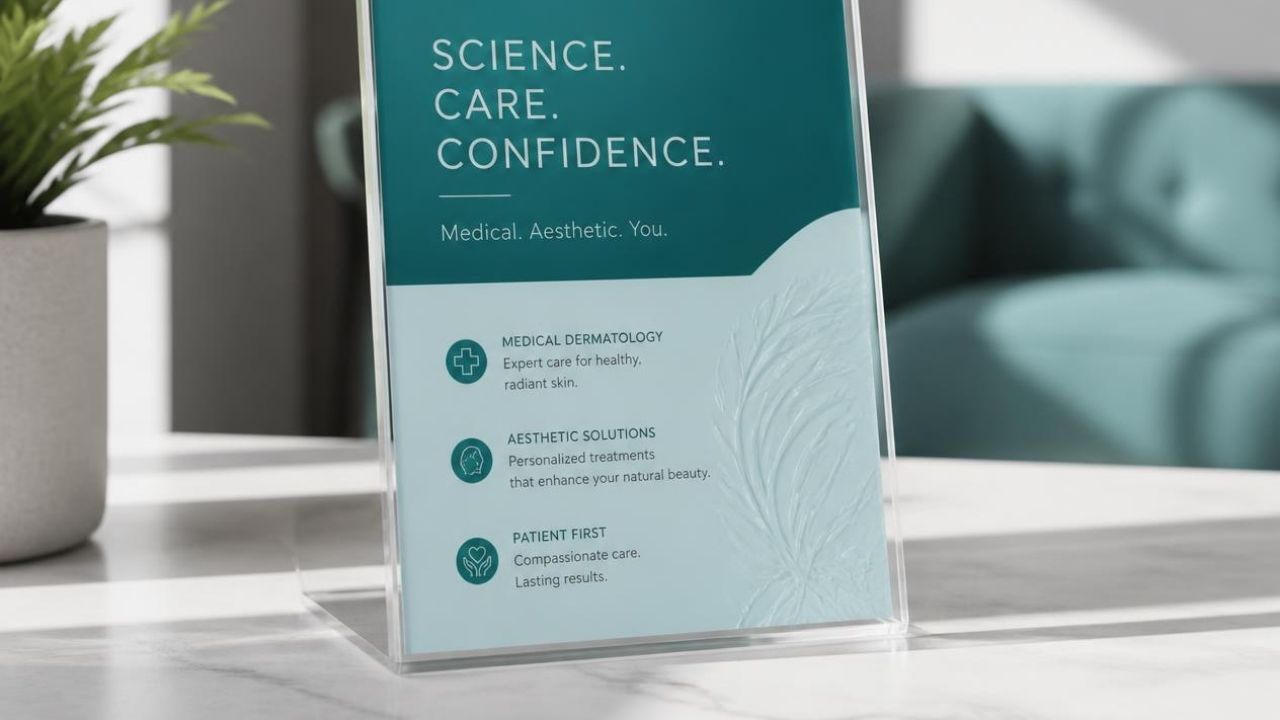
Not all clear plastic is the same, and picking the wrong one costs more than it saves. Acrylic, PETG, styrene, rigid PVC, and polycarbonate each behave differently under stress, sunlight, cleaning chemicals, and everyday wear. A material that looks identical on a shelf can crack at a mounting hole, yellow in a window, or scratch after a single wipe with the wrong cloth, depending on which plastic it actually is. Our premium acrylic sign holders take the guesswork out of material selection, delivering optical clarity and long-term durability already matched to the demands of commercial display environments.
This guide breaks down what separates these five materials, what actually causes displays to fail, and how to get the most durability for your budget. You'll see where thickness matters more than material grade, why some common cleaning advice is wrong, and which vendor claims deserve a second look before you buy.
Key Takeaways
- Increasing sheet thickness delivers more real-world durability per dollar than switching to a different polymer, and it's the cheapest upgrade available.
- Cast acrylic only outperforms continuous acrylic where real stress exists, like cold bends or drilled holes. On a flat panel, they perform the same.
- Cleaning technique matters more than the cleaning product. Soap, water, and a damp microfiber cloth prevent more damage than any specialty cleaner.
- The "no ammonia" rule is a myth. Alcohol content, fragrance additives, and dry-wiping are what actually damage acrylic.
- Polycarbonate wins on impact strength by a wide margin, but acrylic wins on clarity, surface hardness, and UV stability without needing a coating.
What Are the Common Plastics Used for Displays?
Five plastics dominate the display industry: acrylic, PETG, styrene, rigid PVC, and polycarbonate. Each one trades strength for clarity, or cost for durability, in a different spot. Knowing where those tradeoffs sit helps you pick the right material instead of overpaying for properties you'll never use.
What Are the Key Properties of Acrylic, PETG, Styrene, PVC, and Polycarbonate?
On paper, these five plastics look similar. In practice, they perform very differently. Acrylic weighs the least (specific gravity 1.19) and carries the highest tensile strength (10,500 psi). Rigid PVC is the densest (about 1.4) and the only one rated V-0 for flammability, thanks to its chlorine content. PETG and polycarbonate sit in the middle on both counts.
Hardness numbers need a caution label. Cast acrylic tests at M-100, PETG at R-115, and PVC also at R-115. But M and R are different Rockwell scales with different indenters, so these numbers can't be ranked against each other, even when they sit on the same spec sheet.
The numbers below summarize how these five plastics compare on paper, side by side:
| Property | Acrylic (Cast) | PETG | Styrene (HIPS) | Rigid PVC | Polycarbonate |
|---|---|---|---|---|---|
| Specific Gravity | 1.19 (lightest) | Mid-range, no published figure | Mid-range, no published figure | About 1.4 (densest) | Mid-range, no published figure |
| Tensile Strength | 10,500 psi (highest) | No published figure | No published figure | No published figure | No published figure |
| Hardness Scale* | M-100 (Rockwell M) | R-115 (Rockwell R) | No published figure | R-115 (Rockwell R) | No published figure |
| Flammability Rating | Not V-0 rated | Not V-0 rated | Not V-0 rated | V-0 rated | Not V-0 rated |
| Light Transmission | 92% | No published figure | No published figure | No published figure | 86% |
| Notched Izod Impact | 0.3 ft-lb/in | No published figure | No published figure | No published figure | 15 to 18 ft-lb/in |
| UV Stability (unmodified resin) | Resists UV without additives | No published yellowing curve | Yellows within about 16 days of accelerated weathering | No published UV data | Needs a UV-stabilizing coating |
*Rockwell M and R are different hardness scales that use different indenters, so figures across these two columns can't be ranked against each other directly.
How Do Optical Clarity and Impact Resistance Compare Across These Plastics?
Acrylic wins on clarity. Polycarbonate wins on impact, by a landslide. Cast acrylic transmits 92% of light and scores just 0.3 ft-lb/in on notched Izod impact. Polycarbonate transmits a bit less (86%) but survives 15 to 18 ft-lb/in, roughly 55 times acrylic's number.
That gap looks scarier than it is. Notched Izod tests a sheet with a deliberate weak point cut into it. Acrylic's unnotched impact score jumps to 7.0 ft-lb, over 20 times higher, because real display panels don't have machined notches. And against actual glass, acrylic holds up well: a 0.236-inch sheet absorbs roughly 9 times the impact energy of quarter-inch plate glass before it breaks.
What Are Their Heat and UV Stability Characteristics?
Acrylic handles heat and sun better than most people expect. It tolerates continuous use up to 180 to 200°F and resists UV without any additives, with most of its color change happening in the first two years and then leveling off. Polycarbonate needs help: its base resin isn't UV-stable on its own, so it relies on a coating. That coating matters enormously. Coated polycarbonate yellows 30 times slower than bare polycarbonate under the same UV exposure. Styrene, by contrast, starts yellowing within about 16 days of accelerated weathering and doesn't stop.
If you're using a display to protect something behind it, like a printed sign or a document, look for UV-filtering grades. Standard acrylic blocks 80 to 90% of damaging UV, and museum-grade versions from both major manufacturers block up to 98%.
How Does Acrylic Manufacturing Affect Display Durability?
"Acrylic" isn't one material. How it's made determines how long it lasts. Cast, continuous cast, and extruded acrylic look identical off the shelf but fail at different rates, and knowing why helps you avoid paying for durability you don't need or skipping durability you do.
What Are the Differences Between Cast, Continuous Cast, and Extruded Acrylic?
Molecular weight is the real difference. Cast acrylic has the highest molecular weight of the three, giving it the best resistance to crazing, those fine surface cracks that form under stress. It tolerates 1.6x the stress before crazing in isopropyl alcohol, 1.4x in toluene, and 2x the sustained load. It also bends 1.7x tighter without cracking.
On strength, impact, and heat resistance, though, cast and continuous acrylic are nearly identical. Tensile strength, notched Izod, and heat deflection all land within a few percentage points of each other. The buyer takeaway: you're not paying for strength when you buy cast acrylic. You're paying for crazing resistance, which is exactly the failure mode that ends most displays and never shows up on a basic spec sheet.
What Causes Acrylic Displays to Fail Indoors?
Five things end an indoor acrylic display, roughly in this order: surface abrasion, crazing, stress cracking at fasteners and edges, edge chipping, and UV yellowing. UV is dead last and barely matters indoors.
Abrasion is the biggest culprit, and it's self-reinforcing. A dry cloth scratches the surface and builds up a static charge at the same time, which then pulls in more dust for the next scratch. No manufacturer publishes a standard abrasion rating for acrylic sheet, and no one publishes numbers for edge chipping either, even though the physics is well understood: a chip is a notch, and a notch is where the next crack starts.
How Do Thickness, Placement, and Cleaning Influence Acrylic Lifespan?
Thickness is the cheapest durability upgrade available. Doubling sheet thickness from 0.118 to 0.236 inches multiplies break energy by 3.5x. Beyond that, gains keep climbing steeply with every step up in gauge.
Placement matters too, but less than people assume. Indoors and away from windows, acrylic shows essentially no UV degradation even after 20 years. Outdoors is a different story: five years in Arizona sun raised haze 24-fold, while yellowing barely moved. Haze, not yellowing, is what actually shows up on weathered acrylic. Keep it away from heat sources too. Acrylic softens above 260°F, well within reach of an incandescent fixture.
Cleaning habits beat all of it. A display cleaned with soap, water, and a microfiber cloth can last 20 years. One sprayed with glass cleaner and dry-wiped with a paper towel can fail in two, regardless of thickness or grade.
What Are Best Practices for Caring and Cleaning Acrylic Displays?
Most acrylic damage isn't the material's fault. It's the cleaning routine. The right products, the right cloth, and the right technique determine whether a display lasts decades or years.
What Cleaning Agents Are Recommended or Avoided for Acrylic?
Soap, water, and a soft cloth are all you need for routine cleaning. Manufacturers also recommend diluted isopropyl alcohol (30% strength), 3% hydrogen peroxide, and kerosene or naphtha for grease. Never use window cleaning sprays, acetone, benzene, carbon tetrachloride, or scouring compounds. These strip or crack the surface.
Read labels closely. The active ingredient often isn't the problem; the formulation is. Liquid hydrogen peroxide is fine on acrylic, but a hydrogen-peroxide wipe from a different brand is flagged as incompatible by the same manufacturer. Alcohol solutions above 10% carry real risk too, so check concentration before you trust a "safe" ingredient.
Why Are Cloth Type and Cleaning Technique More Important Than the Cleaner?
The cloth matters more than the bottle. Every major manufacturer treats cloth as a way to carry water to the surface, never as an abrasive on its own. A dry or gritty cloth causes scratches and builds static, and that static pulls in more dust.
That's how minor damage snowballs. Dust lands on a statically charged panel, someone sprays it and wipes it dry, the trapped dust scratches the surface, the surface hazes, and the haze invites even more wiping. Breaking that cycle starts with one rule: never wipe acrylic dry.
How Can Scratches and Static Charge Be Managed for Acrylic Displays?
Scratch repair depends on depth. Fine hairline scratches respond to wax or polish, which fills them rather than removes them. Minor scratches can actually be buffed out with a plastic scratch remover and a flannel pad. Deeper scratches need wet sanding with fine-grit sandpaper, followed by buffing. Gouges from keys or blades are permanent. One exception: scratch-resistant coated sheet should never be buffed, since polishing thins and damages the coating itself.
Static is a different problem with a different fix. Acrylic's insulating properties are what attract dust in the first place, and compressed air won't clear it. A damp wipe works. An antistatic coating, reapplied roughly every few months, works better. The simplest floor protocol: damp-wipe instead of dusting, skip compressed air, and apply antistatic cleaner on a regular schedule.
How Do Alternative Plastics Compare in Formability and Chemical Resistance?
Acrylic isn't always the right call. When a display needs deep forming, chemical exposure resistance, or a specific end-of-life profile, PETG, styrene, and polycarbonate each offer something acrylic doesn’t.
What Makes PETG and Styrene Ideal for Formed Displays?
PETG is built for complex shapes. It handles deep draws and precise molded details without losing structural integrity, and it thermoforms fast, at low energy, with no predrying required. That last point saves real production cost, since acrylic needs drying before it can be thermoformed. PETG shows up in P.O.S. displays, price-tag holders, shelf partitions, and directional signage for exactly this reason.
Styrene (HIPS) is the other formability standout. It thermoforms easily and takes glue, paint, and print well, which makes it common in point-of-purchase displays, kiosks, and printed graphics. Acrylic can still be formed, just differently: it molds at low pressure into low-cost wood or plastic tooling, which keeps custom runs affordable. But cold-bent acrylic only holds its shape inside a frame. On its own, it springs back.
How Resistant Are Other Plastics to Chemicals and Abrasion?
Acrylic resists more than people expect and less than the marketing suggests. It handles alkalis, acids, and light hydrocarbons well, but acetone, benzene, and toluene dissolve it outright. Independent testing backs this pattern up loosely: producers rate acrylic's chemical resistance "Poor" against solvents specifically, while calling it "excellent" against acids and alkalis. Both are true, depending on what the display is exposed to.
Polycarbonate tells a similar story on abrasion. Bare polycarbonate scratches badly under steel wool testing, losing over 28% clarity. A factory hard coat cuts that damage by roughly 40x. It's still about 40 times softer than glass even with the best coating, which is the tradeoff you accept for polycarbonate's impact strength.
What Are Their Recyclability Profiles?
Acrylic recycles cleanly, and recycled content doesn't cost you durability. Regrind acrylic performed as well as, or better than, virgin resin in real-world weathering tests. Acrylic sheet also contains no heavy metals, halogens, or BPA, and it doesn't produce toxic gas when it burns.
The other materials are murkier. PETG is marketed as recyclable, though its labeled recycle code may be inaccurate on some datasheets. No solid recyclability data exists for rigid PVC, styrene, or polycarbonate. The honest takeaway: recyclable in principle isn't the same as recycled in practice, and no manufacturer publishes real recovery rates for display sheet.
How to Bridge Material Properties with Cleaning and Handling Protocols
Buying the right plastic is only half the job. How it's stored, handled, and installed determines whether those properties actually hold up. Most premature failures trace back to handling, not the material itself.
Why Is Material Choice Insufficient Without Proper Handling?
Storage mistakes cause damage before a display ever gets installed. Store acrylic on edge, not flat, and keep the temperature under 125°F in a ventilated, moisture-controlled space, away from paint booths or solvent fumes. Vapor alone can attack the surface; no direct contact needed. Never nest formed pieces either; stacked weight will permanently deform them.
Masking paper is a countdown clock, not permanent protection. The longer it sits, especially outdoors or in heat, the harder it becomes to remove without damaging the surface underneath. Use older stock first, and never cut into masking carelessly. A scored surface loses impact resistance, the same weak point that causes drilled holes to crack.
How Do Stress and Chemical Exposure Interact to Cause Damage?
Crazing needs two ingredients at once: stress and a chemical. Neither one alone causes it. Under tension, a chemical wedges between the polymer's molecular chains, opening tiny voids that scatter light and appear as fine, directional cracks. This is why crazing shows up at mounting holes, bent edges, and welded joints; those are exactly where stress concentrates. A flat, unstressed panel rarely crazes, even with the same chemical exposure.
That's also why manufacturers insist on testing any cleaner under real conditions first. Stress level, temperature, and exposure time all change the outcome, so a chemical that's safe on one part of a display can still damage another.
What Precautions Minimize Stress Cracking and Surface Wear?
Acrylic expands and contracts more than the materials it usually replaces, moving roughly 8 times more than glass and 3 times more than an aluminum frame. Framing needs to account for that. Build channel framing deep enough for full movement, and skip rigid fasteners that don't allow for expansion.
Edges matter just as much. Sand or scrape any edge that will take an impact. A notch-free edge holds up far better than a rough-cut one, since breakage resistance drops sharply wherever a notch gives a crack somewhere to start.
What Are the Cost Considerations for Plastic Displays?
Sticker price tells you almost nothing about what a display actually costs over time. Purchase price, service life, and handling all factor in, and the cheaper material on day one isn't always the cheaper choice by year five.
How Does Price Vary Among Acrylic, Polycarbonate, and Others?
Acrylic costs less upfront. At matched thickness, acrylic runs about $4.44 to $4.73 per square foot, while polycarbonate runs $6.24, roughly 35% more. Treat these numbers loosely, though. The same acrylic SKU moved 6.6% in price between two listings taken the same day, and no reliable pricing data exists for PETG, styrene, or rigid PVC at all.
Resin costs are also moving industry-wide. Trade reports from early 2026 point to broad price pressure across major resins, plus rising costs on the stabilizers and additives that go into them. Expect some volatility no matter which material you choose.
How Does Display Service Life Affect Total Cost of Ownership?
Purchase price only tells half the story. Modeled over a 10-year service life, acrylic runs about $0.46 per square foot per year, and polycarbonate about $0.62. Stretch that out and the total cost gap narrows fast, since neither material has a published service-life rating for indoor use.
Real-world testing supports the longer window. Outdoor acrylic samples showed no meaningful discoloration, crazing, or clarity loss after 20-plus years in punishing sun exposure, and one held over 90% light transmission after a decade outside. Indoors, that means cost of ownership comes down to handling, not polymer. Scratching, crazing, and fastener damage drive replacement, not material choice. Our durable wall mounted brochure holders are built on that same proven material, giving lobbies, hallways, and waiting areas a long-lasting literature display that stays clear for years with minimal upkeep.
Why Is Thickness Often a More Cost-Effective Durability Factor Than Polymer?
Thickness beats material switching, dollar for dollar. Impact resistance climbs steeply with gauge, making a thicker sheet the cheapest durability upgrade available, and one that doesn't require a new supplier or cleaning routine.
That's also why polycarbonate's price premium matters less than it looks. Once service life is factored in, that 35% gap disappears into the noise of a normal replacement cycle. The real cost decision isn't which resin to buy. It's how well the display gets handled and cleaned.
Here's how the purchase price and the annualized cost compare once service life is factored in:
| Metric | Acrylic | Polycarbonate | PETG, Styrene, and Rigid PVC |
|---|---|---|---|
| Upfront cost per sq ft (matched thickness) | $4.44 to $4.73 | $6.24, about 35% more | No reliable published pricing |
| Annualized cost over a 10-year service life | About $0.46 per sq ft per year | About $0.62 per sq ft per year | No published service-life cost data |
What Are Unverified Claims and Key Knowledge Gaps in Plastic Display Research?
Not every spec sheet claim holds up to scrutiny. Some numbers simply don't exist yet, and some manufacturers disagree with each other outright. Knowing where the gaps and conflicts sit helps you spot a shaky vendor claim before you buy on it.
Which Data on Abrasion, UV Exposure, and Pricing Are Incomplete or Conflicting?
Real gaps exist, even in well-studied materials. No manufacturer publishes a standard Taber abrasion rating for any of the five display plastics, despite a test built specifically for that purpose. Rockwell hardness gets used as a stand-in, but it's reported on incompatible scales across materials, so it doesn't actually work as a comparison.
UV data has similar holes. PETG has no published yellowing curve over time, rigid PVC has no UV stability data at all, and nobody quantifies how much UV actually reaches a display sitting behind a window, which is where most retail displays live. Treat any number for these as unverified until a manufacturer proves otherwise.
How Should Buyers Approach Vendor Claims Without Primary Source Validation?
Not all sources carry equal weight. A manufacturer's own published test data outranks a distributor repackaging someone else's numbers, which outranks a single retail price captured on one day. When a claim traces back to the actual material producer, trust it more.
Two habits protect you further. First, remember heat deflection temperature isn't a service-temperature rating; it's a single lab measurement, not a green light for continuous use at that temperature. Second, always check specimen thickness before comparing a vendor quote to any published number, since the same property tested at two thicknesses isn't the same number. And be skeptical of any "X hours of accelerated testing equals Y years outdoors" claim. Even the companies that build the testing chambers say no reliable conversion factor exists.
What Are the Common Conflicts in Producer Recommendations?
Manufacturers don't always agree, even on their own products. One brand calls household ammonia "excellent" for cleaning acrylic; two others tell customers to avoid window cleaners entirely. The chemistry actually sides with the first claim, since ammonia at normal concentrations barely affects acrylic. It's the alcohol and fragrance in most spray cleaners that cause damage, not the ammonia itself.
Other conflicts are harder to resolve. Two manufacturers' own accelerated-weathering claims differ by roughly a decade's worth of interpretation for similar test hours. Polycarbonate's impact rating varies by three points depending on which datasheet you read. PETG's light transmittance differs by five points between two producers. Acrylic's maximum service temperature swings by 40°F across sources. None of these gaps has a single right answer in the public record, so when a claim matters for your application, ask the specific manufacturer for their number, not the industry average.
Integrated Insights on Selecting and Maintaining Plastic Displays for Budget-Conscious Businesses
Everything above points to the same conclusion: durability comes from a handful of decisions, not from picking a premium material and hoping for the best. Here's what actually moves the needle.
Thickness beats polymer switching every time. A slightly thicker sheet of acrylic delivers more real durability per dollar than jumping to a different material, and it doesn't require a new supplier or cleaning routine. Save the cast-acrylic upgrade for parts under real stress, like cold bends, drilled holes, or sustained load. On a flat panel, cast and continuous acrylic perform the same, so the premium buys nothing.
Cleaning habits matter more than cleaning products. Soap, water, and a damp microfiber cloth cover nearly every case, and a dry cloth causes more damage than most chemicals do. The "no ammonia" rule people repeat is misdirected too. Realistic ammonia concentrations barely touch acrylic. Alcohol, fragrance additives, and dry-wiping are the real culprits, and any one of them can undo good technique.
Two more things worth knowing before you buy. Scratch-resistant coated sheet can't be polished later, since the coating and the polish are mutually exclusive. And any vendor claim converting lab hours into years of real-world life deserves skepticism. Even the people who build weathering test chambers say there's no reliable formula for that conversion, and different manufacturers have published numbers for the same test that disagree by a factor of ten.
Get Displays That Are Built to Last
Choosing the right plastic is only half the equation. The other half is working with a manufacturer who gets the details right, from material grade to edge finishing to fastener design.
Displays & Holders has been manufacturing acrylic and plastic displays in-house since 1986, right here in Anaheim, California. We've helped more than 100,000 businesses get displays that hold up, not just ones that look good on day one. Need help figuring out which material and thickness actually fit your budget and your environment? Our team will walk you through it.
Custom orders start at just 50 units, and in-stock items ship same-day when ordered before 2 PM PST. Ask about our custom display sign holders to match your exact branding, dimensions, and mounting needs for a solution built around your space. Call us at 714-527-1179 or reach out online to get started.
Frequently Asked Questions
Q1. Which plastic material lasts longest in outdoor display applications?
A. Acrylic tends to outperform the other four plastics over long-term outdoor exposure. Test samples left in direct sun for 20-plus years showed no meaningful discoloration, crazing, or clarity loss, and one sample kept over 90% light transmission after a decade outside. Polycarbonate offers stronger impact resistance, but its base resin needs a UV-stabilizing coating to avoid yellowing, since it isn't UV-stable on its own. For most outdoor signage, coated acrylic at a sufficient thickness gives the strongest combination of clarity and weather resistance.
Q2. Is thicker acrylic always worth the extra cost?
A. In most cases, yes. Doubling sheet thickness from 0.118 to 0.236 inches multiplies break energy by roughly 3.5 times, and durability keeps climbing with every additional step up in gauge. Thickness is a cheaper upgrade than switching to a different polymer, and it doesn't require a new supplier or a different cleaning routine. For high-traffic or high-stress locations, a thicker acrylic sheet usually delivers more real-world durability per dollar than a premium material grade.
Q3. Why do acrylic displays crack or craze at mounting holes?
A. Crazing happens when stress and chemical exposure occur at the same location. Under tension, a chemical wedges between the polymer's molecular chains and opens tiny voids that scatter light, which appears as fine, directional cracks. Mounting holes, bent edges, and welded joints concentrate stress, so those are the spots where crazing shows up first. Sanding rough edges before installation and using channel framing deep enough for thermal expansion both reduce the risk.
Q4. What cleaning products should never be used on acrylic displays?
A. Avoid window cleaning sprays, acetone, benzene, carbon tetrachloride, and abrasive scouring compounds, since these strip or crack the acrylic surface. Alcohol solutions above 10% concentration and cleaners with fragrance additives carry real risk too, even when a product markets itself as acrylic-safe. Soap, water, and a soft, damp microfiber cloth handle almost every routine cleaning need. The most damaging habit is dry-wiping the surface, since a dry cloth scratches acrylic and builds a static charge that pulls in more dust.
Q5. How much more does polycarbonate cost than acrylic, and is it worth it indoors?
A. At matched thickness, polycarbonate runs about $6.24 per square foot compared to $4.44 to $4.73 for acrylic, a premium of roughly 35%. Modeled over a 10-year indoor service life, that gap narrows to about $0.62 per square foot per year for polycarbonate versus $0.46 for acrylic. Indoors, where scratching, crazing, and fastener damage cause more failures than the polymer itself, the added impact strength of polycarbonate often goes unused. For most indoor budget-conscious applications, acrylic delivers comparable long-term value at a lower starting price.