










Selecting the right sign holder material determines whether displays maintain a professional appearance during high-traffic periods or require frequent replacement. The acrylic vs plastic sign holders debate centers on balancing initial investment against long-term durability and brand perception. Material performance directly affects maintenance costs, customer experience, and visual consistency across retail locations during seasonal peaks.
Businesses face increased pressure during busy seasons when displays endure constant customer interaction and environmental stress. Understanding the durability comparison between acrylic and plastic helps procurement teams make cost-effective decisions that protect brand image. This analysis examines material characteristics, pricing structures, and deployment environments to identify which option delivers superior ROI for seasonal signage applications.
Key Takeaways
- Acrylic sign holders last 10-30+ years, while plastic holders require replacement every 1-5 years
- Acrylic maintains 92% light transmittance and resists yellowing for decades, while plastic degrades within 1-3 years
- Total cost of ownership favors acrylic at $1.00 annually versus plastic at $2.00 annually over the product lifetime
- Polycarbonate offers 30x stronger impact resistance than acrylic but sacrifices optical clarity and scratch resistance
- Premium display materials increase product purchases by 80-478% and generate approximately 217 Euros in weekly sales increases
Acrylic Vs. Plastic Sign Holders Explained
Acrylic sign holders are display products manufactured through thermoforming polymethyl methacrylate, creating rigid structures with glass-like transparency. Plastic sign holders typically use injection-molded polystyrene, PVC, or polycarbonate materials, offering varied performance characteristics. Both materials serve POP (Point-of-Purchase) communication functions at retail locations where product information and promotional content require visibility.
Acrylic provides 92% light transmittance and maintains transparency for decades without yellowing. Plastic alternatives offer lower production costs but exhibit reduced longevity and faster aesthetic degradation.
Definitions and Key Material Characteristics
Thermoformed polymethyl methacrylate is the manufacturing process for acrylic sign holders, creating precise shapes through heat and mold pressure. Injection-molded plastics use granulated resin forced into molds under high pressure, producing budget-friendly units with variable quality.
POP (Point-of-Purchase) communication refers to signage at retail locations designed to influence purchasing decisions.
Common Types of Acrylic and Plastic Holders
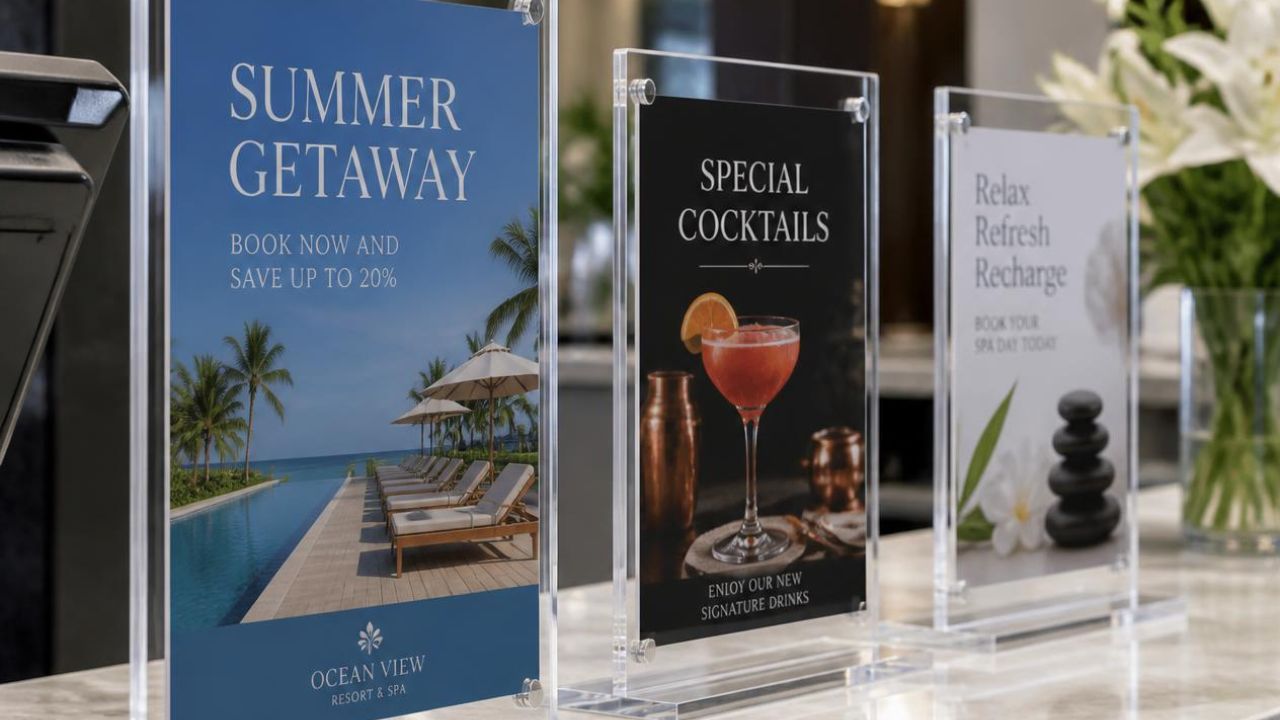
Slant Back Sign Holders feature an angled design positioning content at an upward angle for ergonomic viewing by standing customers. This configuration improves readability at checkout counters and reception desks. QSR chains and corporate reception areas rely on countertop displays for standardized brand communication across multiple locations.
Table Tent Menu Holders offer top or bottom-loading designs with double-sided visibility and compact footprint for table placement. Side-loading frames allow content insertion from the side, enhancing security against tampering in high-traffic environments. Wall-mounted sign holders ad frames feature fixed installation with frameless or framed options conserving counter space.
Typical Use Cases in Retail and Hospitality
QSR chains use slant back sign holders at checkout counters where promotional content requires immediate visibility during transaction completion. Franchise networks standardize slant back holders through centralized procurement to maintain brand consistency.
Restaurants, cafes, hotels, and event venues use table tent menu holders for seasonal menu changes and promotional announcements. Office buildings, healthcare facilities, and educational institutions use wall-mounted sign holders for compliance notifications and wayfinding.
Acrylic Vs. Plastic Sign Holders: Key Material Differences
Material performance varies significantly across durability, optical properties, and structural characteristics that determine long-term value. Acrylic delivers superior optical clarity and scratch resistance while plastic offers budget-friendly initial pricing. The fundamental difference lies in lifespan expectations, with acrylic lasting 10-30+ years compared to plastic's 1-5 year replacement cycle.
Cost-effective sign holder selection requires analyzing total ownership expenses rather than purchase price alone. Plastic yellows within 1-3 years due to UV degradation while acrylic maintains 90% transmittance after 30 years.
| Property | Acrylic | Plastic |
| Typical lifespan | 10 to 30+ years | 1 to 5 years |
| Light transmittance | 92%, about 90% after 30 years | Lower, degrades over time |
| Scratch resistance | Rockwell M 94 to 105 | Soft surface, scratches fast |
| Impact behavior | 17x stronger than glass | High risk of cracking |
| UV and yellowing | Resists yellowing for decades | Yellows within 1 to 3 years |
Durability and Lifespan Comparison
Acrylic lifespan ranges from 10-30+ years depending on deployment environment and maintenance practices. Plastic lifespan averages 1-5 years before yellowing and cracking compromise visual presentation.
Acrylic maintains 90% transmittance after 30 years through superior UV stability and molecular structure. Plastic yellows within 1-3 years as UV exposure breaks down polymer chains, creating visible discoloration.
Optical Clarity and Scratch Resistance
Acrylic offers 92% light transmittance, matching optical glass while eliminating weight and fragility concerns.
Acrylic scratch resistance measures Rockwell M 94-105, significantly outperforming polycarbonate at Rockwell M 70-75. Polycarbonate's softer surface shows visible scratching within months in high-traffic environments.
Impact Resistance and Structural Strength
Polycarbonate is 30x stronger than acrylic in impact resistance, making it suitable for applications where physical abuse is expected. However, this advantage comes at the cost of reduced optical clarity and increased scratching. Acrylic is 17x stronger than glass, providing adequate impact protection for typical retail environments without glass's safety risks.
Material selection depends on whether impact resistance or optical clarity takes priority. High-traffic areas with potential for physical contact may justify polycarbonate despite aesthetic compromises.
Cost and Value Comparison of Acrylic and Plastic Holders
Initial purchase price differences narrow significantly when analyzing the total cost of ownership over the operational lifespan. Plastic/Polystyrene budget tier pricing ranges from $1.25-$5.00 per unit, while acrylic budget tier starts at $2.00-$10.00. This upfront premium delivers substantial long-term savings through extended replacement intervals and maintained appearance.
Value assessment must account for replacement frequency, labor costs, and brand perception impacts. Acrylic's durability eliminates recurring procurement cycles and installation labor accompanying plastic replacement schedules. Superior optical clarity throughout product life protects premium brand positioning that scratched, yellowed plastic undermines.
| Cost factor | Acrylic | Plastic |
| Budget tier unit price | $2.00 to $10.00 | $1.25 to $5.00 |
| Mid tier unit price | $10.00 to $35.00 | $5.00 to $15.00 |
| Typical replacement cycle | 10 to 30+ years | 1 to 2 years |
| Annual cost over lifetime | about $1.00 | about $2.00 |
Initial Purchase Price Ranges
Plastic/Polystyrene budget-tier pricing spans $1.25-$5.00 for basic designs without customization. Mid-range tier pricing reaches $5.00-$15.00 for improved thickness and UV stabilizers, extending lifespan marginally.
Acrylic budget tier pricing ranges from $ 2.00 to $ 10.00 for standard designs with basic dimensions. Mid-range tier pricing extends to $10.00-$35.00 for enhanced thickness, custom sizing, and improved hardware. Premium tier pricing reaches $25.00-$100.00+ for custom shapes, specialized finishes, and integrated branding elements.
Total Cost of Ownership Over Time
Total Cost of Ownership (TCO) accounts for initial investment plus replacement costs over the product's lifetime. An acrylic holder at $10.00 lasting 10 years costs $1.00 annually when depreciated linearly. A plastic holder at $4.00 replaced every 2 years costs $2.00 annually, doubling long-term expenses.
Plastic holders typically require replacement every 1-2 years as UV degradation and scratching degrade the professional appearance. Annual cost comparison demonstrates acrylic at $1.00 per year versus plastic at $2.00 per year. Labor expenses for removing and installing replacement units add additional hidden costs favoring durable materials.
Effects of Customization and Bulk Purchasing
Customization adds a 30-40% premium to base costs for logo etching, frosted finishes, and non-standard dimensions. This premium applies proportionally across all material categories, maintaining relative cost relationships.
Bulk orders reduce per-unit costs by up to 60% through economies of scale in material purchasing and production efficiency. Multi-location operators benefit from centralized procurement, consolidating orders across franchise networks.
Consumer Preferences That Shape Material Choice
Consumer perception of retail environments directly correlates with display quality and visual presentation standards. 82% of shoppers prefer clear displays that build brand trust through professional appearance and content visibility. Scratched, yellowed plastic holders negatively impact brand trust by signaling neglect and low-quality standards.
Material performance affects customer experience during shopping journeys, particularly in premium retail environments. Display clarity influences product perceived value and purchase intent.
Brand Perception During Peak Retail Seasons
82% of shoppers prefer clear displays that build brand trust through transparent communication and professional aesthetics. Premium materials signal quality commitment, influencing store selection and repeat visits.
Scratched, yellowed plastic holders negatively impact brand trust by undermining premium positioning through visible degradation. During busy seasons when displays suffer increased wear from constant customer interaction, material performance gaps become apparent. Acrylic's maintained clarity protects brand perception throughout seasonal peaks while plastic deterioration accelerates.
Maintenance and Ease of Use Considerations
Side-loading and top-loading designs facilitate rapid content changes without removing entire units from display positions. Quick-change capabilities become critical during seasonal transitions requiring frequent promotional updates.
Industry-Specific Adoption Trends
Metal holds 38% market share in sign holder materials through dominance in high-traffic and industrial applications requiring maximum durability. This material serves airports, transit facilities, and outdoor environments where extreme conditions exceed acrylic's capabilities.
Acrylic holds 28% market share and is growing through expansion in premium retail visual merchandising applications. Plastic/Polycarbonate/PETG holds 20% market share concentrated in high-volume QSR contracts where unit economics dominate specification decisions.
Deployment Environments That Favor Acrylic or Plastic
Environmental conditions and usage patterns determine optimal material selection for specific deployment scenarios. High-traffic counters experience constant customer interaction, requiring superior scratch resistance and maintained clarity. Space-constrained settings prioritize compact designs with reliable mounting systems supporting frequent content updates.
QSR chains use slant-back sign holders at checkout counters where transaction speed demands instant message comprehension.
High-Traffic Counters and Checkout Areas
QSR chains use slant-back sign holders at checkout counters where promotional content must communicate clearly during brief transaction windows. These environments experience continuous customer interaction throughout operating hours, creating intensive wear conditions. High-traffic retail areas use side-loading frames for security against accidental displacement by shopping bags and customer movement.
Franchise networks standardize slant back holders through centralized procurement portals, ensuring brand consistency. Slatwall displays complement checkout signage by maximizing vertical space for impulse purchase merchandising. Acrylic's scratch resistance maintains a professional appearance despite thousands of daily customer interactions.
Table Tent and Slant Back Holder Applications
Restaurants, cafes, hotels, and event venues use table tent menu holders for seasonal menu updates and promotional campaigns. These units must survive frequent handling by servers during table preparation and customer repositioning during meals.
Table Tent Holders are expected to reach USD 0.56 billion by 2034, with a CAGR of 3.8%, reflecting sustained demand growth. Slant Back Sign Holders sized at USD 187.4 million in 2026, serve countertop applications requiring upward viewing angles. Acrylic dominates premium restaurant applications where menu presentation directly influences guest experience.
Wall-Mounted and Space-Constrained Settings
Office buildings, healthcare facilities, and educational institutions use wall-mounted sign holders for compliance notifications requiring permanent visibility.
Business card displays integrate with wall-mounted signage systems for comprehensive visitor information presentation. Acrylic's lightweight properties simplify installation while maintaining structural integrity over extended deployment periods.
ROI Gains From Smart Sign Holder Selection
Strategic material selection aligns display investments with operational requirements and brand positioning objectives. Products in high-quality acrylic units experience purchase increases ranging from 80% to 478%, according to documented retail studies. Average weekly sales increase attributed to premium display units is approximately 217 Euros per unit, demonstrating measurable financial impact.
ROI optimization requires matching material characteristics to specific viewing environments and traffic patterns. Countertops require slant-back holders providing upward viewing angles for standing customers. Tables and center aisles require top-loading or bottom-loading holders supporting multi-directional traffic flow.
Evaluating Viewing Ergonomics and Placement
Assess the viewing environment to match the holder design with customer sightlines and interaction patterns. Countertops require slant-back holders positioning content at upward angles for ergonomic viewing by standing customers. Tables and center aisles require top-loading or bottom-loading holders offering double-sided visibility for bidirectional traffic approaches.
Limited counter space suggests wall-mounted options or compact table tents, maximizing vertical display area. Window displays should leverage custom acrylic shapes, creating intriguing storefront showcases attracting foot traffic.
Aligning Material Choice With Brand Image
82% of shoppers prefer clear displays that build brand trust through transparent product communication. Acrylic offers superior optical clarity (92% light transmittance) versus other materials, ensuring printed content remains vibrant and readable.
Metal dominates high-traffic and industrial applications, whereas acrylic is preferred for premium retail visual merchandising. Urban markets show higher adoption of premium acrylic and metal, versus rural markets favoring budget-conscious plastic alternatives. Most popular displays demonstrate market preferences across diverse retail segments.
Strategies for Reducing Replacement Frequency
Acrylic requires a higher upfront investment but lower total cost of ownership than plastic through extended replacement intervals. Selecting materials matching the deployment environment intensity prevents premature degradation, requiring unplanned replacement expenses.
Seasonal Challenges That Affect Sign Holder Performance
Peak retail periods create intensive operating conditions, testing material performance limits through increased customer interaction and environmental stress. Displays suffer increased wear during busy seasons when foot traffic multiplies and handling frequency accelerates. Seasonal signage must maintain a professional appearance despite conditions that rapidly degrade inferior materials.
Temperature fluctuations, UV exposure, and physical contact combine to create challenging environments for display materials. Plastic has a high risk of cracking under impact during busy holiday seasons when rushed customers and staff create accidental contact. Material performance determines whether displays enhance or undermine brand perception during critical revenue periods.
Wear and Tear During Peak Shopping Periods
Displays suffer increased wear during busy seasons when customer traffic and staff handling multiply the normal contact frequency. Plastic's softer surface shows visible scratching within weeks of intensive use, compromising professional appearance.
Plastic has a high risk of cracking under impact during busy holiday seasons when hurried customers create accidental contact. Acrylic's superior hardness (Rockwell M 94-105) resists daily wear from cleaning and repositioning without visible degradation. Maintaining transparency throughout seasonal peaks protects brand positioning when customer perception matters most.
UV Exposure and Environmental Stressors
Plastic holders prone to yellowing within 1-3 years due to UV exposure breaking down polymer molecular chains. Window displays and outdoor applications accelerate this degradation through direct sunlight exposure.
Acrylic maintains 90% transmittance after 30 years through superior UV stability and a molecular structure resisting environmental degradation.
Handling and Risk of Accidental Damage
Polycarbonate is 30x stronger than acrylic in impact resistance, making it suitable for applications expecting physical abuse.
Glass has limited use due to fragility and weight constraints, creating safety risks in public environments. Acrylic provides 17x stronger impact resistance than glass without safety concerns from potential shattering. Busy seasons increase accidental contact frequency from shopping bags, strollers, and hurried customers testing structural integrity.
Balancing Durability, Cost, and Brand Impact in Acrylic Vs. Plastic Sign Holders
Material selection decisions balance immediate budget constraints against long-term operational costs and brand positioning objectives. Acrylic delivers superior material performance through maintained optical clarity, scratch resistance, and extended lifespan, justifying premium pricing. Total cost of ownership analysis consistently favors acrylic over plastic when evaluating multi-year deployment scenarios.
Businesses operating in premium retail environments benefit most from acrylic's sustained professional appearance during high-traffic periods. Seasonal signage requirements demand materials surviving intensive customer interaction without visible degradation, undermining brand trust. Strategic material selection protects marketing investments by ensuring displays maintain effectiveness throughout operational life.
Order Durable Acrylic Sign Holders From Displays and Holders
Displays and Holders manufactures acrylic sign holders in-house in Anaheim, California, and has served more than 100,000 customers since 1986. Our team ships in-stock items the same day on orders placed before 2 PM PST, and we produce custom runs from just 50 pieces. Tell us where your displays work hardest, and we will match you with holders built to hold their clarity through your busiest months. Call 714-527-1179 or request a custom quote to price your order. You can also contact our team for help choosing the right material and size for every location.
Frequently Asked Questions
Q1. Are acrylic sign holders worth the higher price than plastic?
A. Acrylic costs more upfront, but it lasts 10 to 30 years while plastic often needs replacement every 1 to 5 years. Across a full lifecycle, an acrylic holder works out to about $1.00 per year versus about $2.00 per year for plastic. The durable option also removes the repeated labor of pulling and reinstalling worn units. For most retail settings, acrylic returns more value over its service life.
Q2. Which sign holder material holds up better during peak retail seasons?
A. Acrylic resists daily wear from cleaning and handling because of its harder surface. Plastic shows scratches within weeks of heavy use and can crack under accidental impact when aisles get crowded. Acrylic keeps its clarity through high-traffic months, which protects brand perception when foot traffic peaks. That stability makes acrylic the stronger choice for seasonal signage.
Q3. Does plastic yellow faster than acrylic?
A. Yes. Plastic holders can yellow within 1 to 3 years as UV exposure breaks down the polymer chains. Acrylic keeps about 90% light transmittance after 30 years thanks to its UV stability. Window-facing and outdoor placements speed up plastic discoloration the most. Acrylic is the safer pick wherever sunlight exposure stays constant.
Q4. When is polycarbonate a better choice than acrylic?
A. Polycarbonate offers roughly 30 times the impact resistance of acrylic, so it suits spots where physical contact or abuse is likely. The trade-off is lower optical clarity and a softer surface that scratches sooner. Standard retail counters rarely need that impact strength and gain more from acrylic clarity. Choose polycarbonate only when impact risk outweighs the need for a clear, scratch-resistant surface.
Q5. Which sign holder style fits countertops and tables?
A. Countertops pair well with slant-back holders that angle content upward for standing customers. Tables and center aisles suit bottom-loading or double-sided holders that stay readable from both directions. High-traffic areas benefit from side-loading frames that resist tampering and accidental displacement. Match the holder design to the viewing angle and traffic pattern of each location.