









Key Takeaways:
- Slanted displays attract 500% more views and improve customer recall by 183% compared to static vertical displays through ergonomic angle positioning between 30-55 degrees.
- Placement location drives 71% performance variance with checkout counters achieving 35% conversion, entrances 32%, while low-traffic corners drop to only 12%.
- Acrylic material delivers optimal performance with 92% light transmittance, Mohs 3-4 scratch resistance, and 10+ year lifespan at $1.75/kg cost point.
- Height positioning at 50-54 inches captures standing adult eye-level while 36-48 inch accessible range ensures ADA compliance and maximum demographic reach.
- Interactive angled displays increase dwell time by 35% and attachment rates by 20%, with each 1% dwell time increase correlating to 1.3% sales increase.
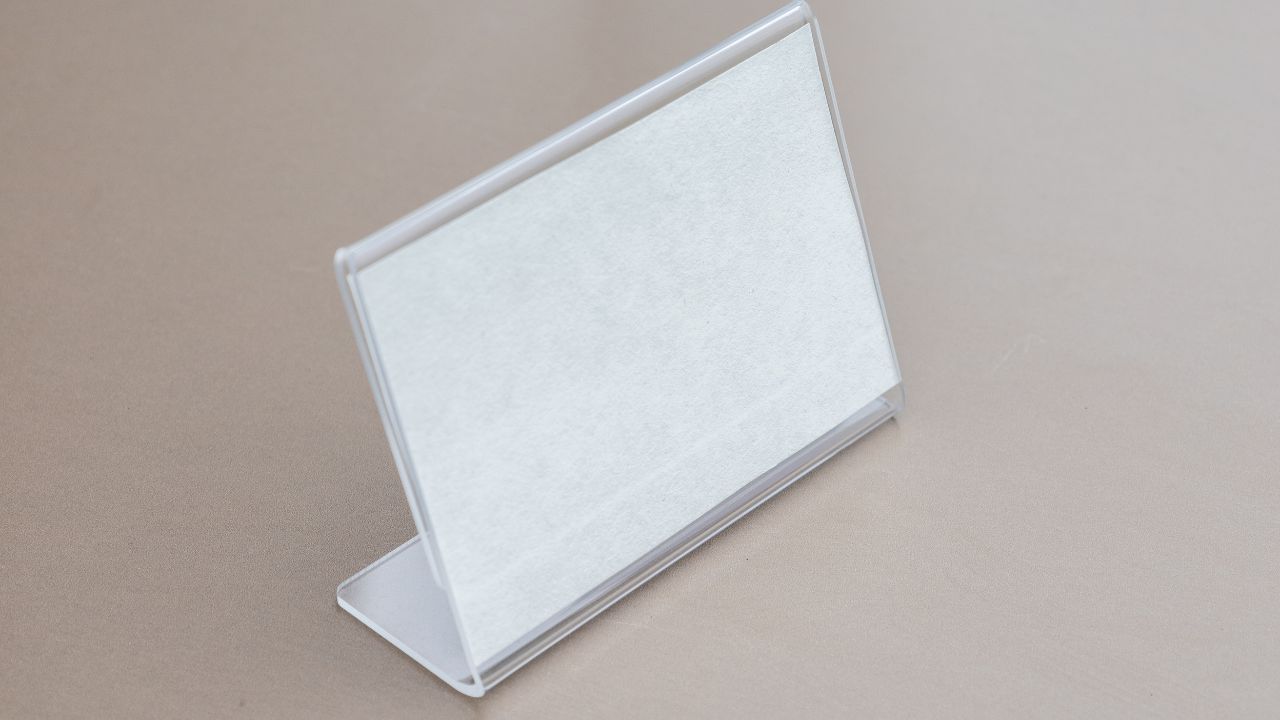
Slanted sign holders outperform vertical displays by 500% in view attraction and 183% in customer recall. Angle optimization between 30-55 degrees creates ergonomic viewing positions reducing neck strain while maximizing readability. This guide quantifies engagement advantages, material specifications, placement strategies, and application-specific performance data.
What Is a Slanted Sign Holder and How Does It Work?
Slanted sign holders position signage at ergonomic angles improving visibility and readability. Understanding angle impact and display mechanics guides effective implementation.
Why Are Slanted Sign Holders Different From Traditional Displays?
Angled displays attract 500% more views than static vertical signage while improving customer recall by 183%. The slant creates perpendicular positioning to natural sight lines maximizing visibility from primary approach angles. Vertical product displays show 90%+ pickup increases versus diagonal orientation, but angled positioning leverages ergonomic advantages vertical flat displays cannot match.
How Does the Angle of a Slanted Sign Holder Impact Visibility?
Optimal angles vary by application: touchscreens perform best at 30-55 degrees off horizontal, roadside signs for drivers at 30-45 degrees relative to street, computer monitors at 15-18 degrees below horizontal. Pedestrian signage achieves maximum visibility in 150-250 cm height zones. Angled displays reduce neck strain by enabling natural gaze positions while perpendicular orientation to traffic flow maximizes approach visibility. The 500% view increase demonstrates angle adjustments significantly impact performance.
What Are the Key Benefits of Using Slanted Sign Holders in Business Environments?
Slanted displays deliver measurable engagement improvements through ergonomic positioning and enhanced visibility. Performance metrics guide implementation decisions.
How Do Slanted Sign Holders Enhance Customer Engagement?
Interactive displays increase dwell time by 35% compared to static presentations. Attachment rates on promoted products lift 20% with interactive displays. Each 1% dwell time increase correlates with 1.3% sales increase creating compounding performance advantages.
How Does the Slant Improve Readability and Visual Appeal?
Angled positioning reduces glare from environmental factors like sunlight while perpendicular angles optimize distant viewing. Right-slanted fonts increase consumer attention and purchase intentions through psychological impact. Angled displays enable more natural reading positions than vertical flat displays reducing viewer fatigue.
Why Do Customers Prefer Interactive Displays That Are Slanted?
Slanted orientation appears more accessible and less imposing than strictly vertical positioning. Ergonomic positioning encourages closer inspection, capturing 500% more views versus static vertical displays. Customer recall improvements of 183% demonstrate memory retention advantages from angled positioning.
How Can Slanted Displays Drive More Customer Interaction and Engagement?
Interactive displays boost dwell time 30-40% versus static alternatives. Visual merchandising with proper angling increases product engagement by 40%. Time spent in-store increases 20% with effective visual merchandising. The 20% attachment rate lift on promoted SKUs proves slanted interactive displays convert browsing to purchasing.
Where Are Slanted Sign Holders Most Effective?
Location performance varies dramatically by placement zone. Industry-specific applications optimize slanted display advantages.
How Do They Perform in Retail and Storefront Settings?
Checkout counter placement achieves 35% conversion representing top retail performance. Store entrance positioning reaches 32% conversion while mid-store high-traffic aisles hit 27% conversion meeting retail averages. Low-traffic corners drop to 12% conversion showing 71% performance variance from optimal placement. Sales increase up to 30% with proper display configuration alongside 40% product engagement improvement and 20% increased time in-store. Strategic integration with merchandise display risers creates cohesive visual merchandising systems.
What Role Do Slanted Displays Play in Restaurants and Cafes?
Host stands and entrance areas capture arriving guests before seating. Waiting area placement leverages captive audiences during wait times. Near-restroom positioning provides high-traffic visibility while exit zones work for takeaway menus and follow-up offers.
Why Are Slanted Holders Effective in Corporate Offices and Waiting Rooms?
Reception areas create first impressions within 40-42 inch standard desk height visibility zones. Interactive displays in waiting zones boost dwell time 30-40%. Patient satisfaction drops from 95.4% for waits under 5 minutes to 80.4% for waits exceeding 30 minutes. Well-designed informational displays offset negative wait perception. Harry's office case study demonstrated reception redesign increased employee productivity perception from 29% to 70% (141% increase) and employee pride from 47% to 98% (108% increase) while workplace effectiveness improved from 48.4 to 71.9 scoring 23.5 points above global benchmark.
How Are Slanted Sign Holders Used at Trade Shows and Events?
Booth entrance positions enable immediate visitor engagement upon approach. Demo area perimeter provides supplementary information without interrupting presentations. High-traffic aisle positions maximize attendee exposure from passing traffic. Interactive displays increase attachment rates on promoted products by 20%. For enhanced visibility in crowded environments, LED-enhanced display stands with built-in illumination dramatically increase attention capture.
What Materials Are Used in Slanted Sign Holders?
Material selection affects clarity, durability, and longevity. Specifications guide application-appropriate choices.
Why Are Acrylic and Plastic Popular Choices for Slanted Displays?
Acrylic delivers 92% light transmittance leading material clarity. PETG reaches 90%, polystyrene 89%, polycarbonate 88%. The 4-percentage point clarity difference between best and worst creates visible degradation. Scratch resistance varies: acrylic rates Mohs 3-4 hardness with Rockwell M 94-105, polycarbonate Mohs ~3 with Rockwell M 70-75, PETG Mohs 3, polystyrene Mohs 2.5 showing lowest scratch resistance.
How Does Material Type Affect Durability and Clarity in Slanted Sign Holders?
Polycarbonate provides 200x glass impact resistance leading durability specifications. PETG reaches 85x glass impact, acrylic 10x glass impact. Acrylic longevity spans 10+ years indoors with 3% UV degradation per decade. Polycarbonate offers 135°C thermal stability representing highest heat resistance. Temperature stability proves critical for outdoor and high-temperature applications.
Which Material Is Most Suitable for Outdoor or High-Traffic Areas?
Material costs range from polystyrene at $1.20/kg (most economical) through acrylic at $1.75/kg (best clarity-to-cost ratio) and PETG at $2.25/kg (balanced properties) to polycarbonate at $3.50/kg (extreme durability). High-traffic retail demands acrylic (Mohs 3-4 scratch resistance, 10+ year life). Outdoor/extreme conditions require polycarbonate (200x impact, 135°C stability). Budget-conscious indoor applications accept polystyrene ($1.20/kg, 89% clarity). Food service prioritizes easy-to-clean surfaces.
What Size and Style of Slanted Sign Holder Should You Choose?
Size and style decisions balance visibility requirements with space constraints. Configuration options accommodate diverse applications.
Should You Choose Single-Sided or Double-Sided Slanted Sign Holders?
Single-sided designs optimize wall-adjacent or directional traffic placement. Double-sided configurations suit center-aisle or 360-degree access positioning. Minimum 42-inch clearance around displays ensures full accessibility. 4-foot (48-inch) minimum aisle width enables comfortable browsing.
What Size Inserts Should You Use for Optimal Visibility?
Common insert sizes span 4" x 6" for compact countertop applications, 5.5" x 7" for table tents, 8.5" x 11" for standard documents (most prevalent), 11" x 17" for large-format promotions. Specialty sizes reach 30" x 40" for specific applications. Optimal eye-level height for standing adults measures 50-54 inches (127-137 cm). Accessible height for wheelchair users maxes at 48 inches. Reception desk standard height sits at 40-42 inches with ADA compliant sections at 36 inches maximum.
How Do You Choose Between Vertical and Horizontal Slanted Designs?
Vertical displays show 90%+ pickup increases versus diagonal orientation. Angled displays capture 500% more views than static verticals. Touchscreen optimal angle spans 30-55 degrees off horizontal. Roadside/driver signage performs best at 30-45 degree angles. Unlike traditional wall-mount displays requiring fixed installation, slanted freestanding units enable flexible positioning.
What Features Should You Consider When Using Slanted Sign Holders?
Feature selection impacts stability, customization capabilities, and content management. Specifications determine application suitability.
How Important Is the Base Stability for Slanted Displays?
Standard tabletop displays require 1.5 lbs base weight minimum. High-traffic environments demand 4 lbs minimum preventing tipping. Outdoor fillable bases withstand 40-50 MPH winds. Weighted bases prevent tipping from accidental contact or air movement. Base dimensions include steel at 1" height x 2.5" depth, metal at 3.5" x 5" footprint, round at 2.0" diameter. Wide footprints and low centers of gravity maximize stability.
Should You Choose a Fully Customizable Slanted Sign Holder?
Standard sizes range $2.50-$4.50 (4x6") to $10.00-$18.00 (11x17"). Custom sizing accommodates unique space requirements. UV printing enables branded graphics. Prototyping services support specialized applications. Adjustable features include tilt mechanisms (0° to 90° range, up to 20° slope), rotation options (180° and 360° configurations), height adjustment (9-17 inches tabletop, 36-51 inches floor stands), and tiered configurations (2-tier, 3-tier, multi-panel options).
How Do Slanted Displays Allow for Easy Updates and Messaging Changes?
Top-loading versus side-loading designs determine update convenience. Insert thickness capacity spans 1/32" to 1/4" range accommodating various material types. Quick-change features suit high-frequency content updates. Maximum thickness accommodations enable diverse material compatibility.
How Do Slanted Sign Holders Contribute to Branding and Marketing?
Branding integration enhances recognition and perceived value. Visual consistency reinforces messaging effectiveness.
Can Slanted Sign Holders Be Custom Printed With Your Logo or Brand Message?
Branded headers and graphics increase recognition by 40% in product engagement studies. Color coordination with facility branding improves visual integration. Professional presentation signals current, maintained content. Consistent branding increases perceived information value and credibility.
How Do They Help Improve Brand Visibility and Customer Perception?
Angled displays attract 500% more views than static vertical displays. Customer recall increases 183% with angled versus static positioning. Professional presentation affects pickup rates independent of content quality. Visual merchandising increases product engagement by 40%. For comprehensive branding solutions, explore custom display options tailored to specific brand requirements.
Why Do Slanted Displays Make Marketing Materials More Noticeable?
Angle positioning reduces glare improving readability. Ergonomic tilt encourages natural viewing position. Perceived accessibility exceeds vertical flat displays. Right-slanted elements increase consumer attention and purchase intentions.
What Are the Best Placement Strategies for Slanted Sign Holders?
Placement strategy determines engagement outcomes. Location selection outweighs display design in performance impact.
Where Should You Place Slanted Displays for Maximum Exposure?
Checkout counters achieve 35% conversion (highest performance). Entrance zones reach 32% conversion. High-traffic aisles hit 27% conversion. Low-traffic corners drop to 12% conversion showing 71% decline from optimal. Entrances and exits serve as natural congregation points. Checkout counters and aisle ends maximize decision-making moments. Waiting areas provide captive audience opportunities.
How Does Placement Near High-Traffic Areas Affect Engagement?
Mid-store high-traffic zones achieve 27% conversion meeting retail averages. Visual merchandising in walkways increases product engagement by 40%. Each 1% dwell time increase correlates with 1.3% sales increase. Avoid passages narrower than 4-foot minimum width preventing bottlenecks.
Should Slanted Displays Be Placed at Eye-Level or Higher?
Optimal standing adult eye-level measures 50-54 inches (127-137 cm). Accessible wheelchair user range maxes at 36-48 inches. Reception desk height references 40-42 inches. Standard office desk height sits at 30 inches. Pedestrian signage optimal zone spans 150-250 cm off ground. Minimum 42-inch clearance around displays enables 360-degree access. 4-foot (48-inch) minimum aisle width ensures comfortable browsing. Front clearance of 72 inches accommodates visitor queuing while 36-inch side clearances enable corridor passage.
What Are the Common Mistakes to Avoid When Using Slanted Sign Holders?
Avoidable errors undermine display effectiveness. Understanding pitfalls prevents performance problems.
Why Should You Avoid Overcrowding the Display Area?
Competing signage creates decision paralysis and information overload. Each additional competing element decreases focus on primary display. Visual clutter reduces individual element effectiveness. Isolated display positioning maintains message clarity. Coordinated sign holder systems prevent competing messages while maintaining cohesive presentation.
How Does Incorrect Placement Lead to Low Engagement Rates?
71% performance variance exists between best (35%) and worst (12%) placements. Hidden placements eliminate impulse engagement. Poor locations prove placement trumps display features. Low-traffic corners show only 12% conversion versus 35% at optimal locations.
What Happens If the Display Isn't Kept Clean or Organized?
Empty pockets signal low value discouraging engagement. Disorganized appearance reduces professional credibility. Full, neat displays convey active maintenance and current relevance. Visual presentation affects pickup rates independent of actual content quality.
How Can You Maintain and Update Slanted Sign Holders for Maximum Effectiveness?
Ongoing maintenance preserves placement effectiveness. Regular attention sustains performance advantages.
How Often Should You Refresh the Content or Materials on Slanted Displays?
Checkout locations (35% conversion) require daily monitoring. Entrance positions (32% conversion) need checks every 2-3 days. Mid-traffic areas (27% conversion) check every 3-4 days. Monthly refills signal poor 12% placement requiring relocation.
What Is the Best Way to Clean and Care for Acrylic and Plastic Slanted Holders?
Acrylic 10+ year lifespan requires proper cleaning and maintaining clarity. Scratch-resistant coatings preserve optical quality (Mohs 3-4 hardness). Avoid abrasive cleaners compromising 92% transmittance. Regular maintenance preserves professional appearance.
How Do Regular Updates Keep Customers Engaged and Interested?
Empty pockets reduce subsequent pickup rates even after restocking. Regular updates signal current, relevant information. Maintenance frequency directly measures placement effectiveness. Visual freshness maintains engagement over time. For automated engagement tracking, smart displays with embedded sensors eliminate manual monitoring requirements.
How Do Slanted Sign Holders Compare to Other Display Styles?
Comparative analysis quantifies slanted display advantages. Performance metrics guide style selection.
What Are the Advantages of Slanted Holders Over Horizontal or Vertical Displays?
Angled displays capture 500% more views than static vertical displays. Customer recall increases 183% with angled versus static vertical. Ergonomic advantage reduces neck strain with natural viewing angle. Visibility improves with better readability from different approach angles. Vertical product displays show 90%+ pickup increase versus diagonal orientation. Slanted is perceived as more accessible than strictly vertical. Angle reduces glare versus flat vertical positioning. Touchscreen optimal range spans 30-55 degrees off horizontal.
How Do Slanted Displays Perform in Terms of Customer Reach and Interaction?
Interactive displays increase dwell time by 35% versus static. 20% attachment rate lift occurs on promoted products. Each 1% dwell time increase correlates with 1.3% sales increase. Visual merchandising increases engagement by 40%, sales by 30%.
Can Slanted Displays Be Combined with Other Display Types for Better Results?
Coordinating slanted holders with complementary display risers maximizes visual impact. Wall-mounted and freestanding combinations cover multiple traffic zones. Multi-level configurations (2-tier, 3-tier) increase content capacity. Hybrid digital-physical displays leverage 500% view advantage.
What Are the Key Takeaways for Using Slanted Sign Holders to Boost Customer Engagement?
Performance data guides implementation priorities. Strategic decisions maximize engagement outcomes.
How Can Slanted Displays Help Improve Visibility and Interaction?
500% more views than static vertical displays (5x visibility multiplier). 183% customer recall improvement (nearly 3x memory retention). 35% dwell time increase with interactive angled displays. 40% product engagement improvement with proper visual merchandising. Touchscreen applications optimize at 30-55 degrees off horizontal. Roadside/driver viewing performs best at 30-45 degrees relative to the street. Computer screen viewing works at 15-18 degrees below horizontal. Pedestrian signage spans 150-250 cm height range.
What Features Should You Prioritize for Maximum Impact?
Angle optimization between 30-55 degrees delivers maximum engagement (500% view advantage). Height positioning at 50-54 inches suits standing adults while 36-48 inches serves accessible range. Base stability requires 1.5 lbs minimum standard, 4 lbs high-traffic environments. Material selection favors acrylic with 92% clarity and Mohs 3-4 scratch resistance for longevity.
Clearance compliance demands 42-inch minimum around display with 4-foot aisle width. High-traffic retail uses acrylic ($1.75/kg, 92% clarity, 10+ years). Outdoor/extreme conditions need polycarbonate ($3.50/kg, 200x impact, 135°C stability). Budget indoor accepts polystyrene ($1.20/kg, 89% clarity).
Where Should You Place Slanted Sign Holders to Get the Best Results?
Checkout counters achieve 35% conversion (top priority placement). Entrance zones reach 32% conversion (second priority). High-traffic aisles hit 27% conversion (third priority). Avoid low-traffic corners at 12% conversion (71% performance drop). 71% difference exists between optimal (35%) and poor (12%) placement. Location selection matters more than display design features. Proper placement combined with angle optimization maximizes ROI. Strategic positioning leverages 500% view advantage of angled displays.
Retail average conversion spans 27% (range 16-38%). Corporate reception impact shows 141% productivity increase, 108% pride increase. Medical waiting rooms demonstrate 15-point satisfaction drop with poor display strategy. Trade shows achieve 20% attachment rate lift with interactive angled displays.
Ready to Leverage Angled Display Advantages That Deliver 500% More Views?
Displays and Holders match slanted sign holder specifications to traffic patterns, viewing angles, and application requirements. Our team applies engagement data (500% view advantage, 183% recall improvement, 35% conversion at optimal locations) and ergonomic standards (30-55 degree optimal angle, 50-54 inch eye-level, 42-inch clearance) to implementation recommendations.
From retail checkout zones achieving 35% conversion to corporate reception areas to trade show booth entrances, we position slanted displays where angles and placement combine for maximum impact. Complement your slanted displays with our versatile acrylic sign holders to build a cohesive visual system that keeps pricing, promotions, and branding working together across every customer touchpoint. Contact Displays and Holders for slanted display solutions backed by quantifiable performance metrics and application-specific specifications ensuring your investment delivers measurable engagement improvements.